Places · 伊万里焼
Imari
Porcelain named for a port, from gilded plant pots to tiny blue ones
Imari ware is porcelain made around Arita and shipped through the port of Imari. Its bonsai pots include blue-and-white pieces and tiny blue pots made for small trees.
Imari ware is the porcelain of Arita, in Hizen — today Saga Prefecture — named for the port of Imari through which almost all of it was shipped. It went to Europe in large quantities, and at home it was made into flower pots: gilded pots for prized plants, and everyday blue-and-white ones. This page follows that history to the bonsai pot, and to what an Imari pot can and cannot tell you.
00 · At a glance
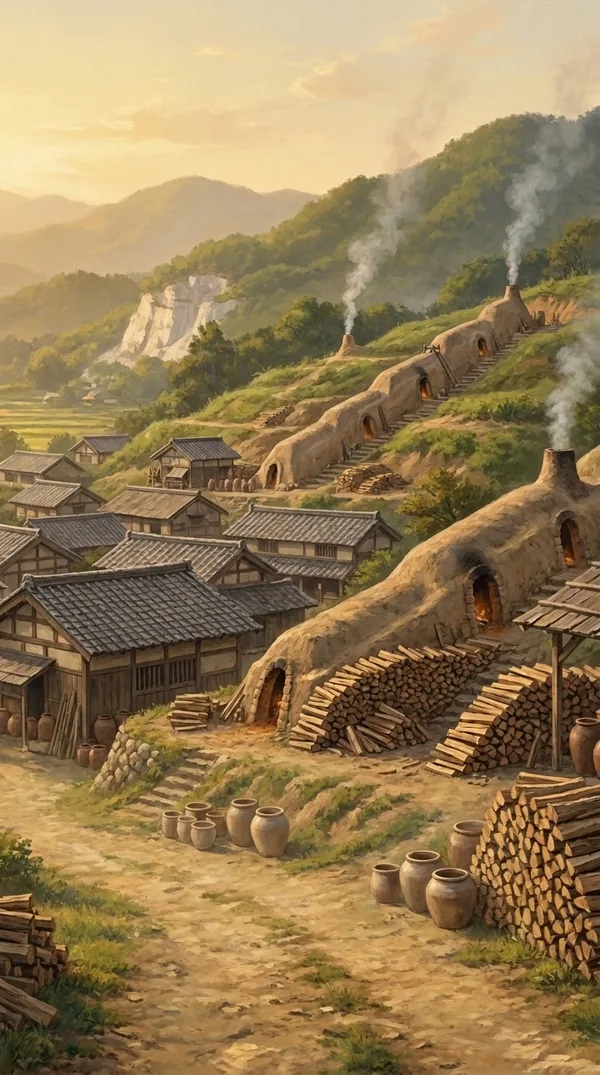
Imari, in four points
The name
From a port
The porcelain was made in and around Arita. Its sale was restricted to Imari, so it was shipped from Imari’s port, and the name Imari stuck.
The material
Porcelain
Arita is described as the place where full-scale porcelain making in Japan began.
The trade
To Europe
From 1659 the Dutch East India Company placed large orders, and Imari porcelain went abroad in quantity.
Bonsai pots
Gold and blue
Gilded Imari pots were luxury pieces for prized plants; blue-and-white pots were everyday ware, made in large numbers.
01 · 有田と伊万里
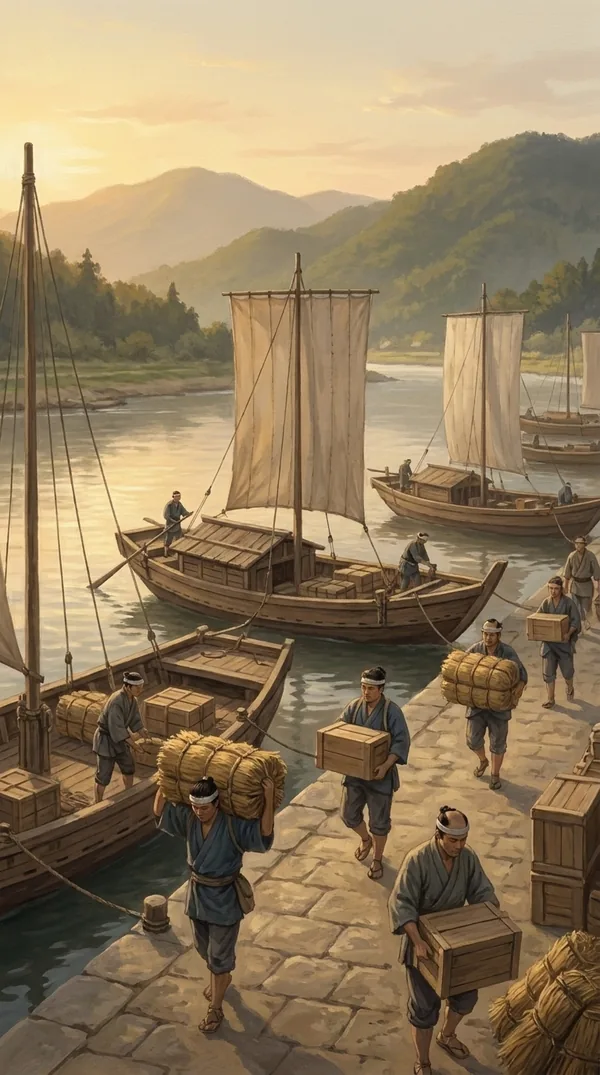
Arita, and the port of Imari
In the account used here, Imari ware refers to porcelain made in and around Arita and shipped through Imari. Fearing that its techniques would leak out, the Saga domain limited where the porcelain could be sold to Imari, so the porcelain made in and around Arita was shipped almost entirely from the port of Imari — and became known by the port’s name.
-
The beginning
Potters from Korea
The source traces Arita ware to Korean potters brought to Japan by 鍋島直茂, founder of the Saga domain, at the time of Toyotomi Hideyoshi’s invasions of Korea.
-
About 1616
Porcelain clay
One of their leaders, 李参平, is recorded as finding good porcelain clay at 泉山 in Arita, and firing celadon, white porcelain and underglaze blue. The date is thought to be about 1616.
-
At first
No overglaze colour
At that stage there was no technique for painting colour over the glaze.
02 · 赤絵のはじまり
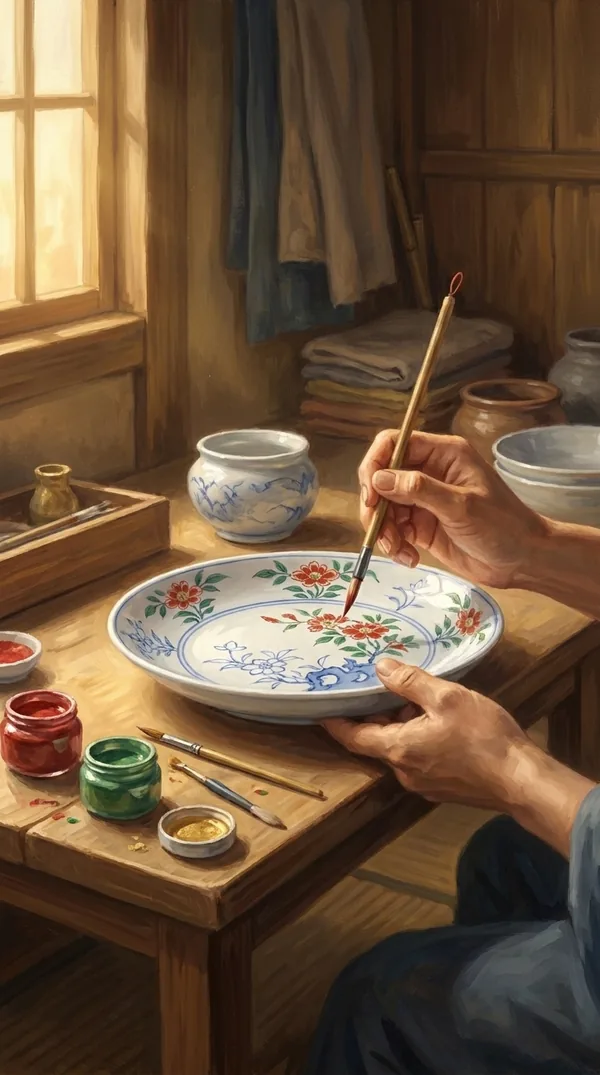
Colour over the glaze
Some decades after the first porcelain, in 1644, the method of overglaze red is recorded as passing to 酒井田柿右衛門. The source notes that it did not work at first, and that success came only after long effort.
The source names a style after him: the Kakiemon style 柿右衛門様式, elegant designs with generous empty space. It describes that use of space as rooted in a Japanese sense of beauty.
03 · 輸出とヨーロッパ
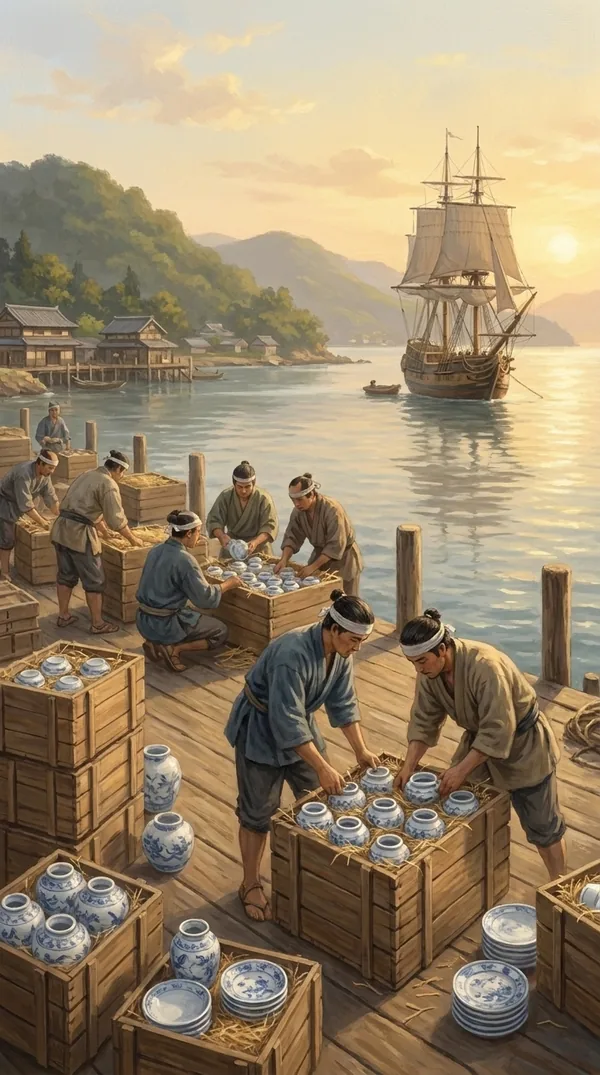
Imari for the world
In the upheaval at the end of the Ming and the start of the Qing, Dutch access to Chinese porcelain was disrupted. In 1659 the Dutch East India Company placed large orders for Imari porcelain, choosing it, the source says, as a substitute that stood at the level of the fine porcelain of Jingdezhen.
-
1659
Large orders
The Dutch East India Company orders Imari porcelain in quantity.
-
Then
Seen as Chinese
Shapes were made to suit European taste. Many of the designs were borrowed from Jingdezhen, so in Europe the porcelain was taken for a kind of Chinese ware.
-
Late 17th century
Recognised as Japanese
Imari kinrande 金襴手, gilded ware — the source also calls it Ko-Imari — is completed and exported widely. The source says that from this point Imari was recognised in Europe as Japanese porcelain.
-
1690s onwards
More and more lavish
The source dates the Imari kinrande style to the 1690s. From the 18th century it grows more lavish, following the taste of a growing townspeople’s culture.
At home, the source says, these wares were favoured by the wealthy — rich merchants and landowning farmers.
04 · 染付・染錦・赤絵・金襴手
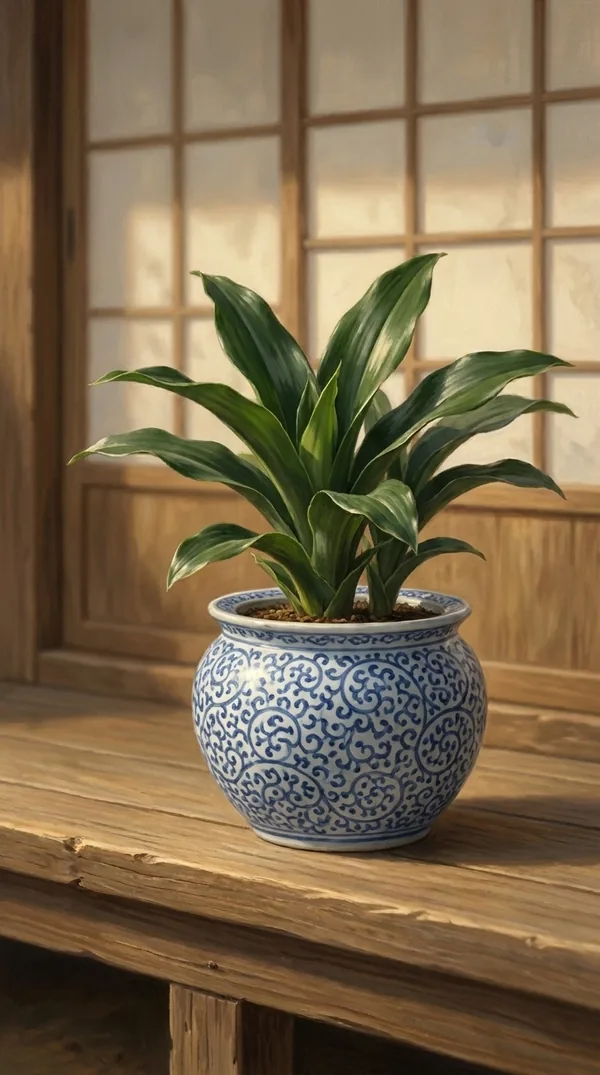
Blue, red and gold
The words used for Imari pots describe how they were decorated.
Underglaze blue
染付
Blue-and-white: designs painted in cobalt blue under the glaze, then fired.
Blue, then colour
Somenishiki 染錦
Somenishiki combines underglaze-blue decoration with overglaze enamels, often including red.
Red
赤絵
A pot coloured mainly in red may be called aka-e. The source notes that red is surprisingly uncommon on Imari bonsai pots.
Gold
Kinrande 金襴手
Gilded ware, rich in red and gold. As a style it dates from the 1690s.
05 · 盆器
Imari bonsai pots
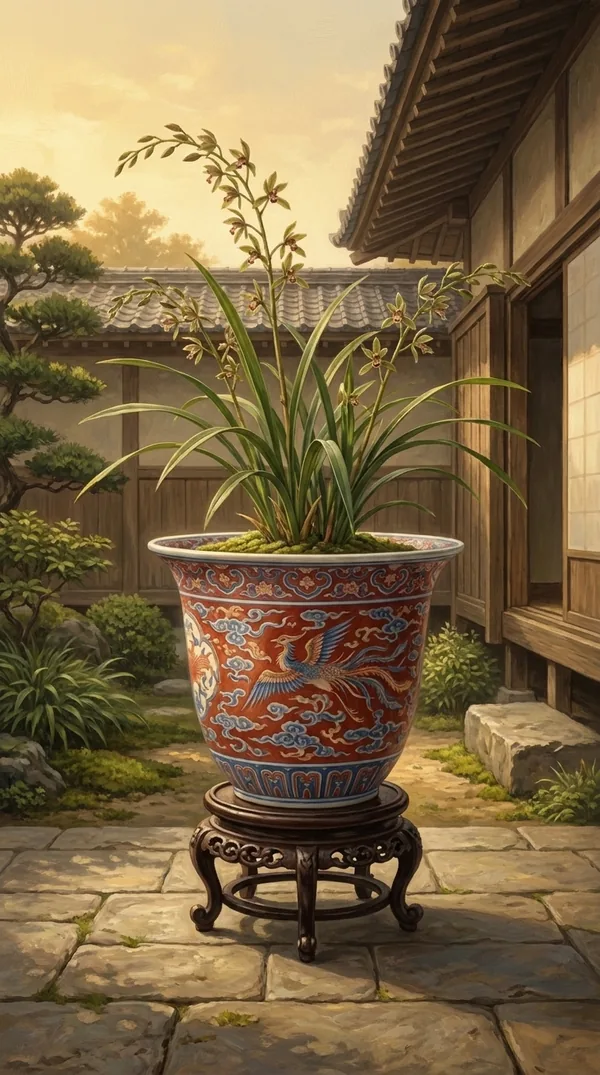
The source presents two contrasting groups of Imari pots. Gilded Imari kinrande pots were called saihimono 西肥物; the source describes them as luxury pieces next to the mainly blue-and-white pots of Seto and Owari. They were used to grow and show plants such as sekishō 石菖, omoto 万年青 and 草玉, and the source says fine examples are prized as display pots.
Blue-and-white Imari, made for everyday use, reached well beyond tableware, to orchid and omoto pots. In this source, Ko-Imari, “old Imari”, is used in more than one way: for the late-seventeenth-century kinrande style, and more broadly for older Imari wares including some blue-and-white pots from the late Edo and Meiji periods.
Large
For prized plants
The large pots recorded run from about 25 to 46.5 cm. One, painted with a dragon and a phoenix, keeps its original drainage hole, ubuana, and shows clear signs of use; the source suggests it probably held orchids, peonies or sago palms in an Edo gardening boom.
Double-walled
Kenjō 献上
A pot with blue landscapes painted on an inner wall, behind an outer wall of pierced openwork. Here, kenjō describes wares made as presentation gifts to the shogunate, the court and daimyo. The source notes that similar pieces often show kiln damage, and takes that as a sign a perfect one was hard to obtain.
Everyday
Tako-karakusa 蛸唐草
Blue scroll pattern, “octopus scroll”. Such pots were made in quantity for the repeated gardening booms of the Edo period; the source notes that complete ones with good age are rare.
A dish, not a tray
Mitate
A shallow Imari dish painted with Dejima, Nagasaki, is recorded. Bonsai growers often use such pieces as trays, but the source treats this one as mainly for display.
06 · 豆鉢
Small and very small pots
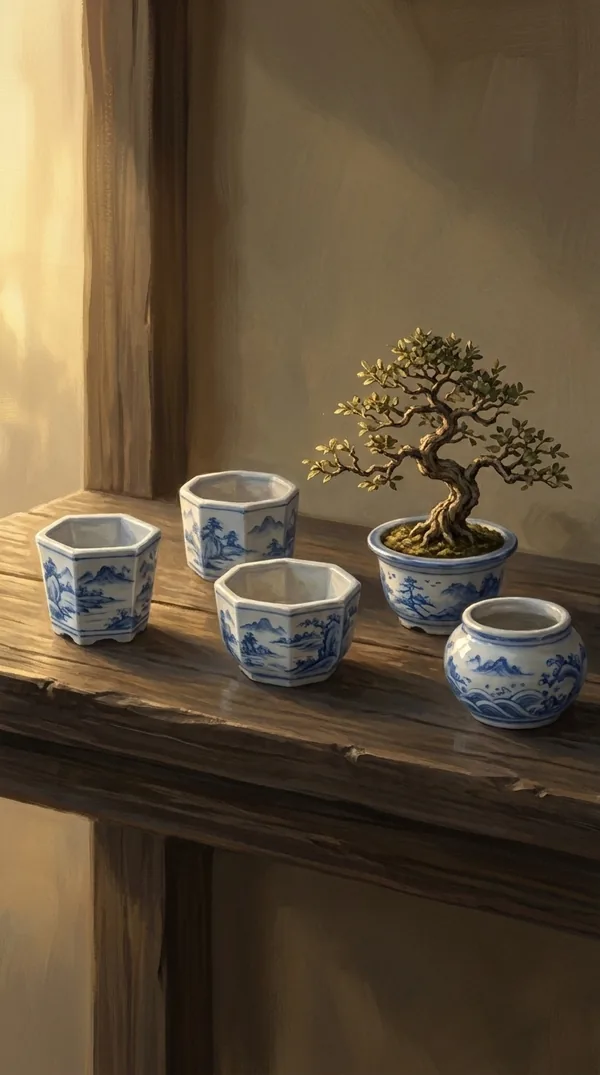
Imari also made pots small enough for the smallest trees. The tiny ones recorded measure 3 to 4.4 cm, all in underglaze blue, in hexagonal, octagonal, round and lobed shapes.
Under 5 cm
For mame bonsai
One collection of tiny pots for very small bonsai, described in the source, included a good number of Imari pots.
A Dutch picture
Copied back
One small blue-and-white pot, 8.8 cm, is said to copy, in a Japanese manner, the painting on Dutch porcelain brought in through Nagasaki. The source calls it very unusual among pot designs.
A tiny landscape
4 cm across
One hexagonal pot shows either a canal town in southern China or the port of Dejima, Nagasaki — the source does not decide which.
Imari carried designs to Europe, and at least once brought a European picture back onto a pot.
07 · 落款と見方
Reading an Imari pot
None of the Imari pots recorded in our source carries a potter’s signature. What appears on the base, when anything does, is a phrase or a word of purpose.
On the base
富貴長春
One gilded omoto pot, 9.6 cm, carries these four characters in blue around its drainage hole. They are an auspicious phrase, not a maker’s name.
Presentation
献上
Kenjō describes a purpose — a presentation gift — not a maker or a date.
Dating
One example
For the dragon-and-phoenix pot, the source reads restrained gold, pale colour and designs also seen on early Imari as signs that it was made soon after the kinrande style appeared. That is the reading of one pot, not a rule for all.
A wider name
Ko-Imari
Ko-Imari is used for pots from the late Edo and Meiji periods as well. It does not, by itself, mean an early pot.
A mark is evidence to weigh, not proof. The marks index sets out the marks recorded so far on this site, and the Kutani page explains why a mark first used on Imari does not make a pot Imari. If a mark puzzles you, send us a clear photograph and we will tell you what it says — we do not issue authentications.
08 · YAKUMO と伊万里
Imari at YAKUMO JAPAN
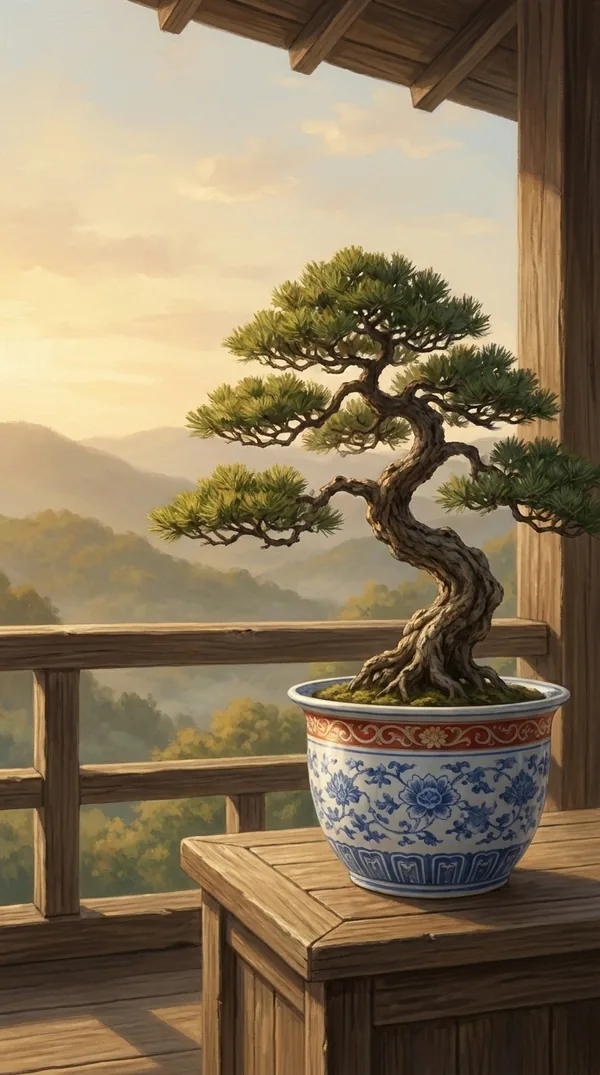
We do not have Imari pots listed at the moment, and our eBay store has no Imari section. Our pots are grouped there by kiln and origin; the link below opens that section, so it always shows what is available now. The pictures on this page are illustrations, not pots for sale.
Later potters have trained in Imari: Ishida Shoseki learned the wheel and painting in Imari, and her pots sit inside the old-Imari tradition.
Browse bonsai pots by kiln and origin on eBay →
Listings ship from Tokyo; destination availability and terms are shown on eBay.
09 · Continue
Keep reading
The marks, glazes and forms on this page each have more to say on their own pages.