Makers · 作家 · Ibaraki
Ishida Shoseki
石田祥石1925–2005
She was growing satsuki azaleas for a living. She began making small pots at fifty, to suit them.
At a glance
- Art name
- Ishida Shōseki 石田祥石
- Real name
- 石田豊美
- Dates
- 1925–2005. She died aged 80
- Region
- Ibaraki
- 1969
- Entered ceramics under the potter 磯博
- At fifty
- Began making small pots, to suit the satsuki she was growing as a business
- Then
- To Imari: the wheel from 馬場文祥, painting from 宮崎陶里
- 1978
- Opened her own kiln
- Work
- Old-Imari patterning, landscapes, animals, figures
- Documented form
- A brushed 祥石 signature
01 · 経歴 Her life
She needed pots, so she made them
She was in the satsuki trade, growing azaleas as a business.
In 1969 she entered ceramics under the potter 磯博. She began making small pots at fifty, for a stated purpose: pots to suit the satsuki she was selling.
She then went to Imari, learning the wheel from 馬場文祥 and painting from 宮崎陶里. She opened her own kiln in 1978.
Her art name came from her teacher: the 祥 is one character out of 馬場文祥’s own name.
Her enthusiasm for small-pot work did not change for the rest of her life. She died in 2005, aged eighty.
02 · 作風 The work
Old Imari, at the size of a pot
Her forming and her painting both sit inside the tradition.
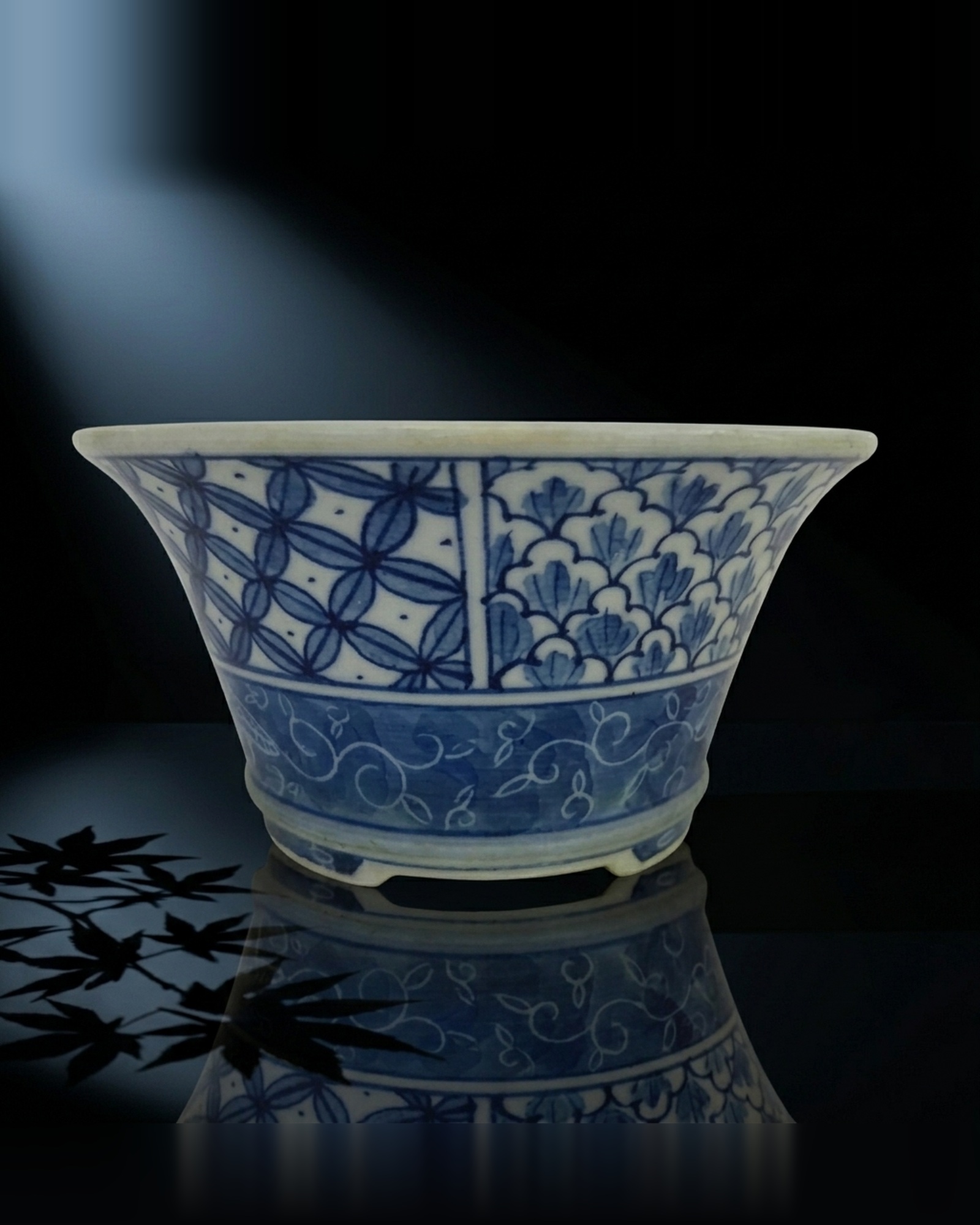
What she painted: old-Imari patterning, landscapes, animals, figures. There are sets built on the fifty-three stations of the Tōkaidō, a series after the Chōjū-giga animal scrolls, and bean pots the size of a fingertip.
03 · 落款 The mark
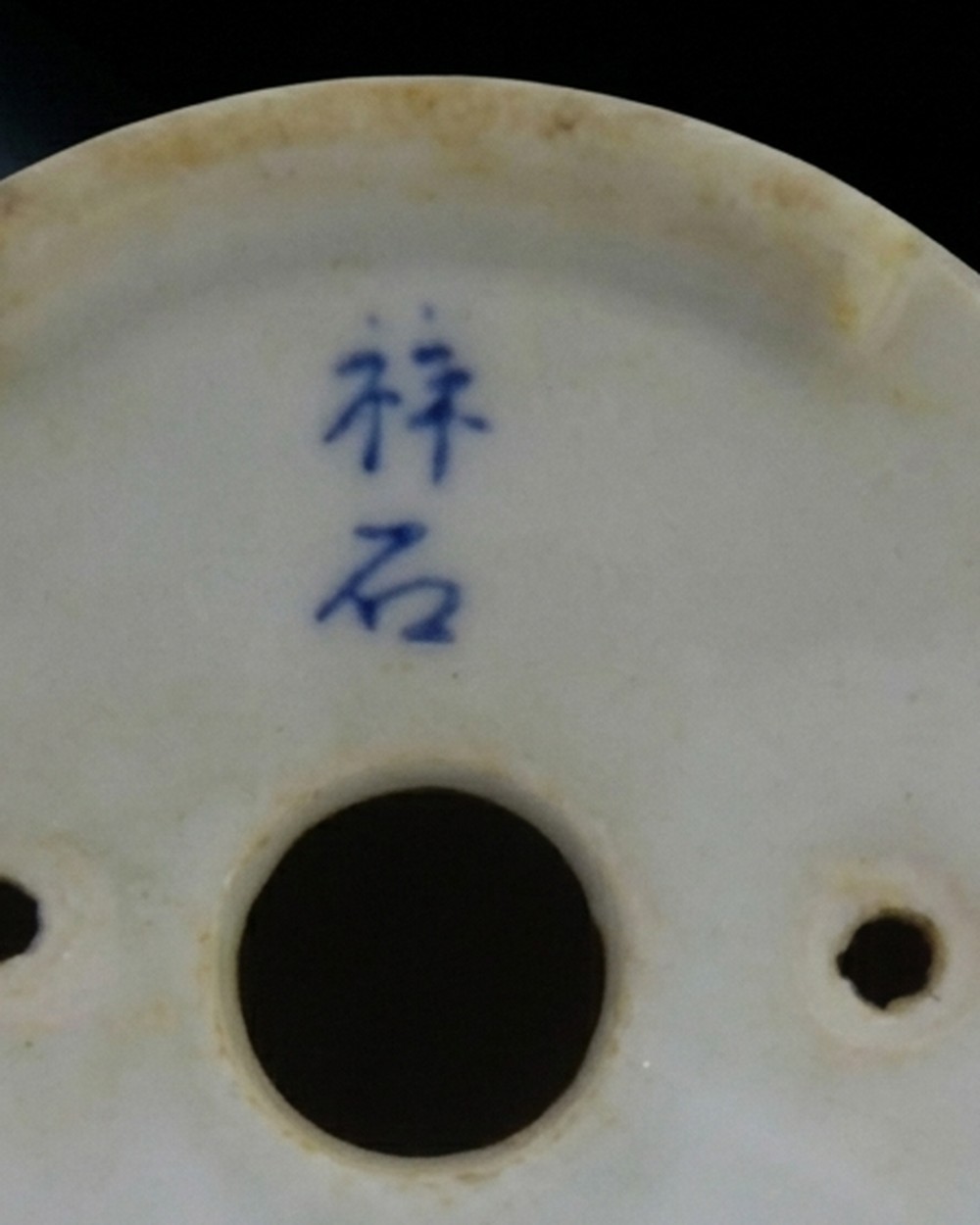
Attributed to Ishida Shōseki · 祥石, two characters one above the other, no frame · brushed in cobalt beneath the glaze · one observed example
A documented brushed form
祥石 — Shōseki.
One mark form documented for her is a brushed 祥石 signature, written in a running hand. Two examples of this form have been observed; other forms may exist.
Shōseki is more than one maker. There is 石田祥石 of Ibaraki, on this page. There is a Matsumoto Shōseki written 松石 — different characters entirely. And there is a ゆうき祥石 kiln, separate again. No relationship between the three is established. They are listed in our index of marks.
Observed examples · 確認例
Marks reading ゆうき祥石
Three mark forms reading ゆうき祥石 have been observed on pots attributed to the present-day Yūki Shōseki kiln: appearing as incised lines in the clay, brushed in cobalt, and impressed as a square seal. These are observed examples, not a complete inventory of the kiln’s marks.
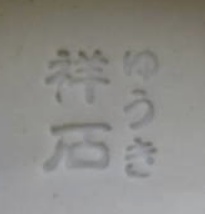
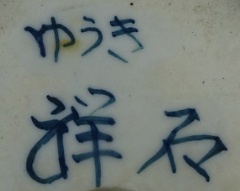
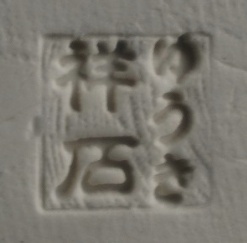
All three photographs are shown uncropped, with plain display margins added by the page layout.
04 · 代表作 Recorded works
Recorded works
Not for sale — works recorded for this maker.
| Work | Size (cm) |
|---|---|
| Hexagon, enamelled — Chinese children at play, on decorative feet | — |
| Round, enamelled — a dragon in red and blue on a white porcelain ground, straight-sided and deep | — |
| Round, everted rim — underglaze blue, the body filled with the linked-shippō pattern | 15.3 × 7.3 |
Available
Shoseki pots in the collection
Each pot ships worldwide from Tokyo. Send us a photograph of the foot and we will tell you what the mark says.