Makers · 作家 · Tōgō, Aichi
Shuzan
舟山1928–1988
He was working at a bank when he built a small downdraught kiln at home, and left the bank three years later. He died before sixty; by 2007 the pots were rated beside old Chinese ware.
At a glance
- Art name
- Shūzan 舟山
- Real name
- 鈴木春司
- Dates
- 1928–1988
- Born
- Tsu, Mie — grandson of 鈴木九蔵, twelfth of a line of seafood merchants
- Father
- A chemist of ceramic materials, with a doctorate — and the reason he came to ceramics
- 1968
- Built a small downdraught kiln at home; worked on ash glazes
- 1971
- Left the bank and potted full time
- Workshop
- Tōgō, Aichi, next to Seto. A second kiln in Tokoname
- Body
- Kibushi clay blended with Chinese clay, fired unglazed
- Method
- Slab-built, thin, reinforced where it matters. Made to order
- Documented forms
- Five
01 · 経歴 His life
A banker who built a kiln at home
He was born in Tsu, in Mie, the grandson of the twelfth 鈴木九蔵 of a line of seafood merchants. His father was a chemist of ceramic materials with a doctorate, and is given as the reason he came to ceramics at all.
He graduated from Meijo University, then worked at a bank while making pottery alongside the job. In 1968 he built a small downdraught kiln at home and worked on ash glazes.
He had been growing bonsai since about 1957, and put that behind a serious attempt at recreating Chinese pots. In 1971 he left the bank and potted full time.
The workshop was at Tōgō in Aichi, next to the great kiln town of Seto. A clean workshop without a speck of dust in it, and the description that goes with it: a meticulous perfectionist. He kept a second kiln in Tokoname and made mould-assisted pots there, but the main line was slab-built work made to order.
He died before he reached sixty. As of 2007 the pots that remain were rated beside old Chinese ware.
He died before he reached sixty.
His clay recipe, his forming and his firing passed to one pupil, Senshū, who had known him for twenty-five years as a friend in bonsai.
02 · 作風 The work
Chinese pots, remade for Japanese eyes
His target was the refined clay and form of old Chinese bonsai ware. He blended kibushi clay with Chinese clay and worked in unglazed stoneware.
He did not stop at copying. Working from the old pots as a base, he made new forms to Japanese taste and a surface of his own.
The method is slab: the body cut into slabs and assembled. The walls are thin, with reinforcement only where it is needed — on one of his largest recorded pots, 72 cm across, the corners are built up and the rest is left thin.
He knew bonsai, and made pots that come into their own with a tree in them. The satsuki growers noticed him first, and the wider bonsai world followed.
The small pots came late. There are not many, and glazed ones fewer still. The same pattern is noted of Gyōzan Nakano: a maker of large pots turning to small ones, and then to glaze, with age.
03 · 落款 The mark
Five documented marks
Five are currently known, and they divide by the size of pot.
| Mark | Reading | Note |
|---|---|---|
| 舟山 | Shūzan, in a square frame, with 総手造証 beside it | For small and medium pots. Thought to be from the middle of his working life onwards. |
| 舟山 | Shūzan, in a maple-leaf outline | Often seen on small pots. Possibly a reworking of the tiny maple mark; the characters run the other way round. |
| 舟山 | Shūzan, in a tiny maple-leaf outline — about 1 cm tall | On small pots, and possibly the earliest. Close to the maple mark of Heian Tōfukuji. At a centimetre it is easy to miss in a listing photograph. |
| 舟山 | Shūzan, plain | Seen on medium pots from time to time. Possibly early. |
| — | A seal in the shape of a Chinese bronze ding vessel | The mark that represents his pots. Mostly on medium and large ones, and there are several versions of it. |
04 · 代表作 Recorded works
Recorded works
Not for sale — works recorded for this maker. Sixteen are currently known, from 7.4 cm to 72 cm.
| Work | Size (cm) |
|---|---|
| Rectangle, outer rim, indented corners, waist band — the class of pot most often used | 44.5 × 35.5 × 13.5 |
| Rectangle, outer rim, cut corners, framed panel, waist band — the design that represents him | 61 × 46 × 18 |
| Rectangle, outer rim — among his largest, and thin for its size | 72 × 55.5 × 11.5 |
| Rectangle, outer rim, flat-hill profile, lower band | 55.5 × 46 × 14.5 |
| Rectangle, inner rim, bamboo-node body band, rounded corners | 40.5 × 31 × 11.5 |
| Square, inner rim, indented corners, framed panel, waist band | 36 × 22.5 |
| Ancient-mirror form, outer rim — a rare form for him | 66.8 × 27.8 |
| Oval, straight-sided, bamboo-node body band — extremely shallow | 52.3 × 39.8 × 4 |
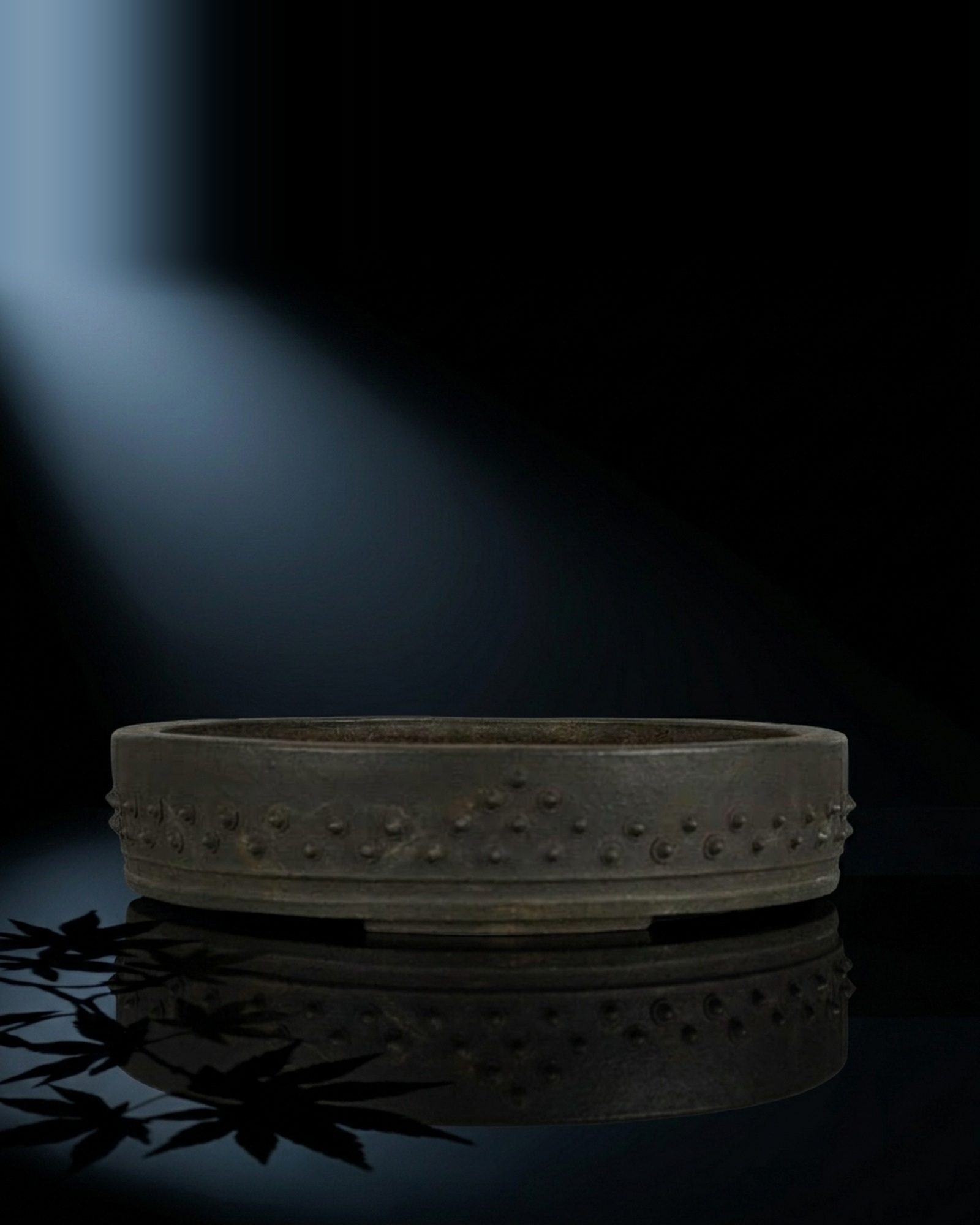
| Round, inner rim, studded, lower band | 37.5 × 6.8 |
| Rectangle, everted rim — a piece of standing, and unusually deep. The decorative foot set between the four feet is unusual | 35.2 × 26.3 × 16.5 |
| Rectangle, inner rim, straight-sided, cloud feet — small | 16.1 × 12.5 × 6.4 |
| Round, everted rim, waist band — small | 14.4 × 7.8 |
| Square, outer rim, waist band, indented corners — marks pressed into all four sides of the body | 14.4 × 10 |
| Round, rope rim — celadon with copper-red splash. Glazed work is rare for him; in Tokoname this manner was used a good deal by Eimei | 13 × 4.5 |
| Square, rounded corners, waist band — his smallest recorded | 7.4 × 6.2 |
| Round, inner rim, studded in two tiers — a rare form | 9.1 × 3.4 |
Available
Shuzan pots in the collection
He died in 1988, so the number of his pots is fixed. Each ships worldwide from Tokyo.
The tiny maple mark is about a centimetre tall and easy to miss. Send us a photograph of the foot and we will tell you what is there.