Makers · 作家 · Tokoname
Gyozan Nakano
中野行山b. 1940
Unglazed clay, from a bean pot that sits in the palm to pieces over 70 cm across. Some of his marks tell you which pots were moulded and which were built by hand — a distinction not generally made in Tokoname.
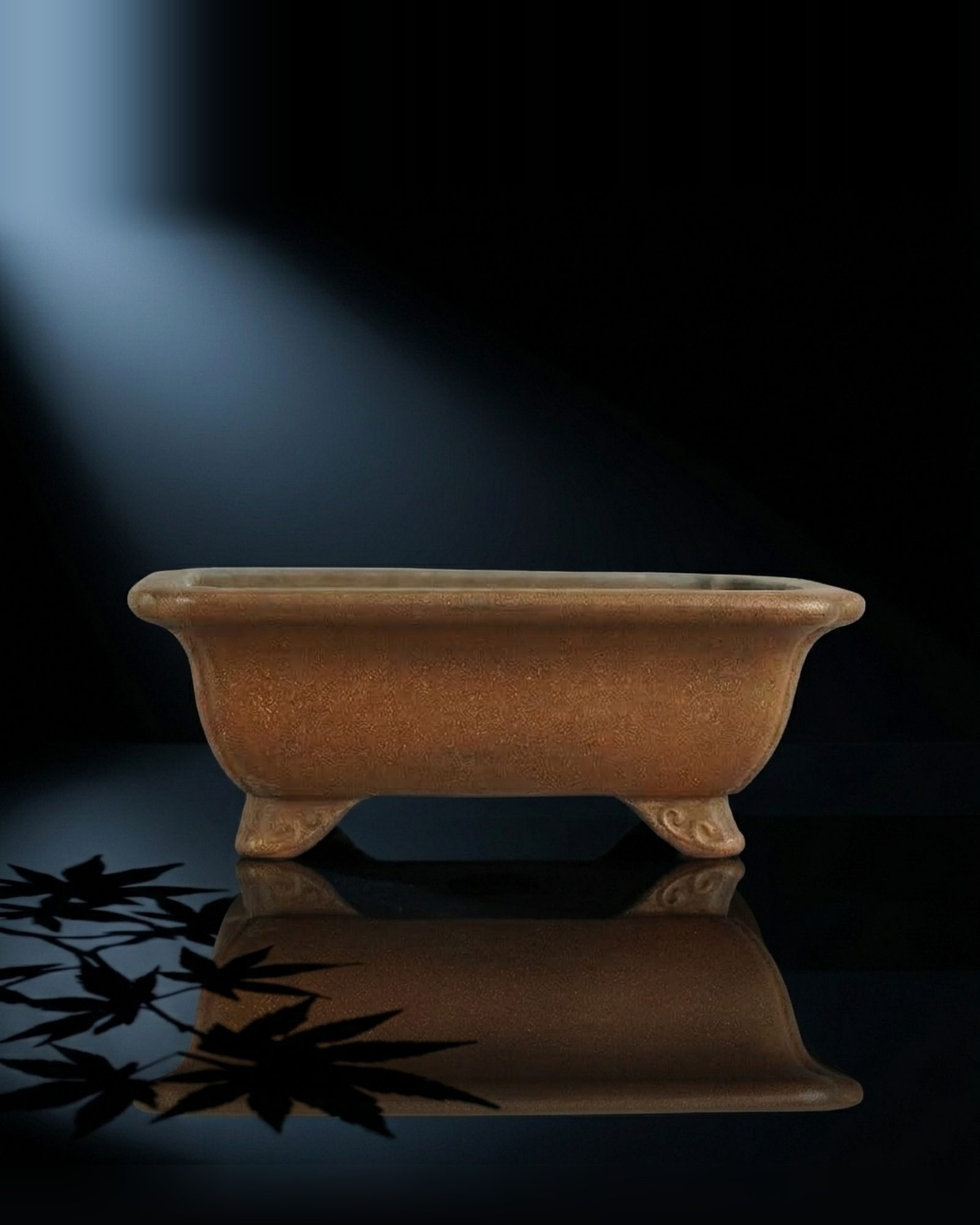
At a glance
- Art name
- Gyōzan 行山
- Real name
- 中野行三
- Born
- 1940
- Region
- Tokoname
- Trained under
- 久田佳山
- 1972
- Set up his own kiln
- Field
- Unglazed clay pots, from small to very large
- About 1976
- Completed a clay of his own, 曙 — akebono, daybreak
- 1984
- Electric kiln to gas; press-moulding to slab and coil building
- 2004
- Published a selected-works book covering thirty-five years
- Size range
- 8 cm to 72.7 cm currently known. He is said to go to about 120 cm, but over 90 cm is rare
- Documented forms
- Four; the recorded associations distinguish moulded and handmade work
01 · 経歴 His life
Two turning points, 1976 and 1984
He trained under 久田佳山 and set up his own kiln in 1972. He works in unglazed clay, across every size and form from small pots to very large ones, and has put his effort into clay materials and firing — recreating the bodies of old Chinese pots: udei, tōkadei, kakidei, shidei, shudei.
1976. He completed a clay of his own and called it 曙, akebono — daybreak. It is made by blending a low-iron clay into the high-iron clay of Tokoname. Before it he worked chiefly in udei and tōkadei; after it, akebono is the centre of the work.
曙 — akebono, daybreak. A low-iron clay blended into the high-iron clay of Tokoname.
The way he varies colour changed with it. Early on he added iron, copper, cobalt and manganese to the base clay; from then on he got the variation out of the firing instead.
1984. The clay being dug in Tokoname changed, and he moved from an electric kiln to gas. Just before that he fell seriously ill, and because a large press mould is very heavy he moved from press-moulding to slab and coil building — to pure handwork. By number, more of his pots are handmade than moulded.
As of 2006 he was spoken of as the leading Tokoname pot maker of the day, in both standing and ability, and his son 裕士 was working as a young maker.
02 · 作風 The work
Kiln-change is not a fault
After the move to gas he worked on firing, and on reduction firing in particular.
Oxidation firing, which both kilns can do, gives an even and predictable result — and that is the problem with it. The pots come out too alike, and it is hard to tell one maker’s from another’s. Reduction is unpredictable: how far it takes is one of several things that will not do as they are told.
Out of that came kiln-changed colour, and some of his best pots.
So the uneven colour on a Gyōzan pot is not a flaw in the firing. A pot like that could be written off as a misfire as a piece of stock; his view is that after some years it will have more character than an even one. He deliberately uses a small kiln with a steep temperature gradient, and tries to steer an accident of the flame that will not repeat.
The same turn to small pots and then to glaze with age is noted of Shūzan.
His glazed pots began around 1985, privately, and there are few of them. His own account of it: there are plenty of people in Tokoname good at coloured pots, and for clean even colour he would be no competition — what he wants from a glazed pot is the interest of the kiln-change. Inlaid coloured clay and carved decoration came the same way, and in the same small numbers.
03 · 落款 The mark
Four documented marks, and what each one tells you
This is the most useful thing on the page. Four marks are documented for him, and they separate the moulded work from the handmade — a distinction not generally made in Tokoname, where press-moulded pots are usually called handmade too.
Other makers on this site use their marks the same way, for different distinctions. Yamaaki separates handmade from production, and Yamafusa marks grade on the older pots and era on the newer. Neither of those readings applies to Gyōzan’s own marks. And it is not general: Heian Tōfukuji used at least seven marks, and which years any of them belongs to is not established.
| Mark | Reading | Note |
|---|---|---|
| 行山造印 | Gyōzan-zō-in — stamped | Goes on pots made with a mould, in some number. An earlier square 行山造 was also used. |
| 中野行山造 | Nakano Gyōzan-zō — written into the clay with a point | Slab-built or coil-built handwork: one-offs or small runs. A sticker reading 中野行山手造鉢 says the same thing. |
| 行山 | Gyōzan — written into the clay with a point | Used on small pots. |
| 近盆二十周年記念 中野行山造 | A commemorative inscription, written in | Anniversary pots carry the occasion. Others exist for the Japan Bonsai Sakufu-ten, the Japan Bonsai Taikan-ten, and Japan Flora 2000 in Awaji. |
The mark that means five pots exist
One design carries a mark he used nowhere else: 翁山, Ōzan, on the copy of an old Chinese double-eared rectangle made in an edition of five. If a pot carries 翁山, it is one of those five.
04 · 代表作 Recorded works
Recorded works
Not for sale — twenty works recorded for this maker, from 8 cm to 72.7 cm.
| Work | Size (cm) |
|---|---|
| Rectangle, outer rim — the pot made when he completed the 曙 clay in 1976 | 48 × 35 × 10 |
| Rectangle, outer rim, indented corners, waist band — moulded, and after ten years of careful use it has taken a fine old colour | 51.3 × 37.7 × 9.5 |
| Rectangle, outer rim, flat-hill profile, lower band — after old Chinese udei, and the age on it is the striking part | 62.7 × 46.6 × 17.9 |
| Rectangle, outer rim, indented corners, waist band — over 70 cm and still shallow enough to be usable | 72.7 × 47 × 16.8 |
| Round, studded, lower band — the old Chinese version of this form has no drainage at all | 40 × 9 |
| Round, outer rim — moulded, and it does not look it. The drainage hole is about the size of a foot | 37 × 7 |
| Sword-lobed — made as a sample for commissions, sized to order | 50 × 42 × 15 |
| Oval, straight-sided — about 70 cm, which is unusual for an oval of his | 70.5 × 53 × 10 |
| Rectangle, outer rim, lower band — a copy of an old Chinese shidei pot, made in an edition of thirty for a 1983 exhibition | 59 × 39 × 17.5 |
| Rectangle, inner rim, indented corners, two ears — a copy of a historic pot, an edition of five, marked 翁山 | 58.5 × 37.5 × 20 |
| Oval, outer rim, waist band, decorative feet | 49 × 42 × 13 |
| Oval, outer rim, waist band, cloud feet — the same form and size as the one above; only the feet differ | 48 × 41 × 14 |
| Round, outer rim, body band | 30.5 × 14.5 |
| Oval, upper and lower bands — buckwheat glaze, kiln-changed. The runs came out more clearly with time than they were on leaving the kiln | 40.5 × 33.5 × 10 |
| Rectangle, inner rim, waist band — oribe glaze, with blue where it pools in the band | 40 × 31 × 10.5 |
| Oval water basin, outer rim — oribe, kiln-changed: red, green and blue, with gold and silver where crystals have come out | 54 × 36 × 5 |
| Oval, bamboo-node decorative rim — wickerwork pattern carved in relief on the body | 49.5 × 40 × 12.5 |
| Rectangle, outer rim, bag form, rounded corners — a properly small pot, described in 2006 as a recent development in his work | 17.5 × 15 × 6 |
| Rectangle, outer rim, indented corners, waist band — white clay inlaid in a panel, a bamboo design. An edition of two, with four other patterns. The reverse is plain, so either side can be the front | 60 × 48 × 16 |
| Rectangle, outer rim, waist band — a bean pot made to a collector’s order, one of one | 8 × 7 × 3.6 |
Available
Gyozan pots in the collection
Each pot ships worldwide from Tokyo.
Send us a photograph of the foot and we will tell you what the mark says — and with his pots some of the marks also indicate how the pot was made.