Places · 高取焼
Takatori
A kiln and a glaze that share one name — and the bonsai pots between them
Takatori ware is the pottery of Chikuzen, in a kiln founded by a Korean potter. The name is shared by a glaze used far beyond that kiln.
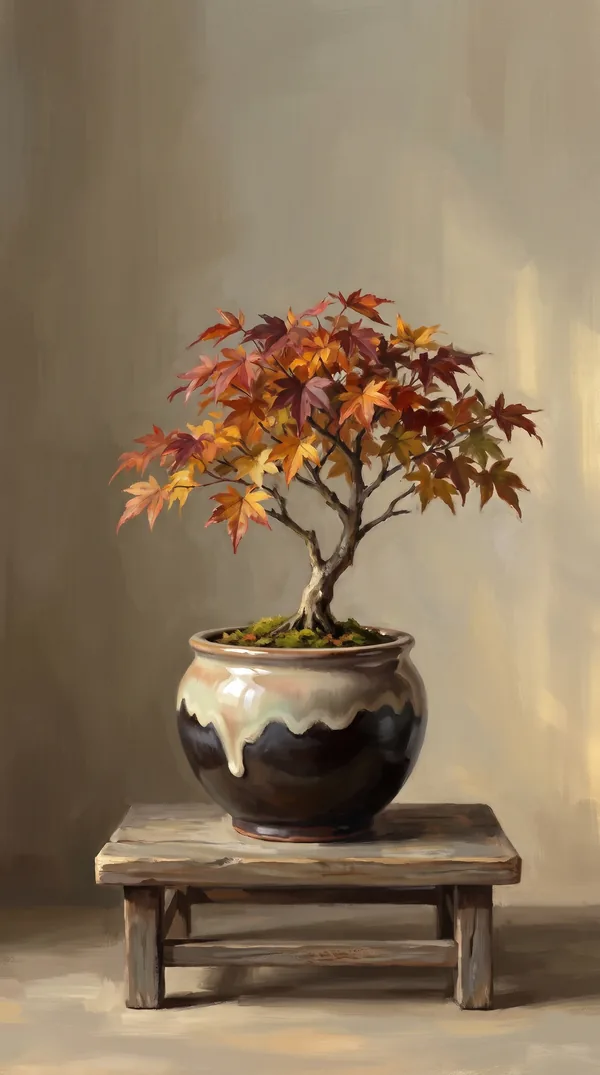
Picture a dark, iron-rich pot with a pale glaze running down from the rim in long drips. In the bonsai trade the word for that look is often “Takatori”. The word names two things. One is a kiln in old Chikuzen, now northern Fukuoka, begun in the early 1600s by a Korean potter. The other is a glaze, used by potters far from Fukuoka. This page is about both, and about keeping them apart.
00 · At a glance
Takatori, in four points
Kiln
Chikuzen, early 1600s
Begun by a Korean potter for the Kuroda lords of Fukuoka, and named after Mount Takatori, at whose foot it started.
Domain
Into the Meiji era
Its kilns moved and multiplied over time. Domain kilns continued until the domain system ended in 1871.
Mark
A circle and one character
The reference records a 高-in-a-circle kiln mark. Such a mark does not by itself establish a kiln, date or authenticity.
Glaze
A name that travels
“Takatori glaze” is also used by other potters, so the glaze alone does not make a pot Takatori ware.
01 · 古高取
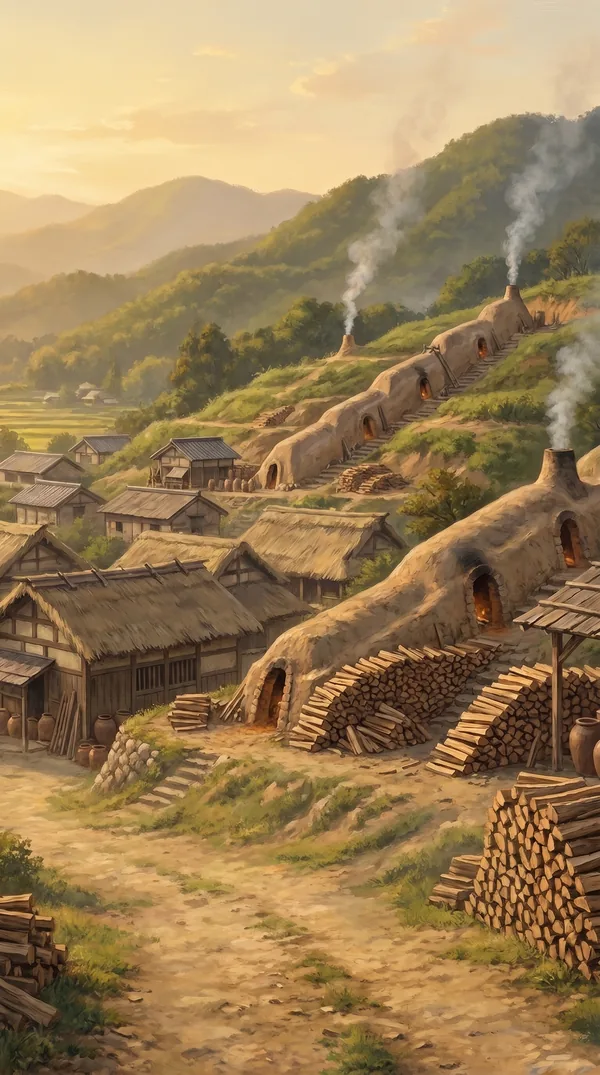
A Korean potter at Mount Takatori
Takatori ware comes from old Chikuzen, the northern part of present-day Fukuoka. Its kiln was built for Kuroda Nagamasa, lord of Fukuoka, by a Korean potter he had brought back from Hideyoshi’s invasions of Korea in the 1590s.
The potter was Hachizan, who took the Japanese name Takatori Hachizō; the lord gave him the name and the standing of a samurai. The first kiln stood at the foot of Mount Takatori, and the name stayed with the ware after the kiln moved. Japanese call this first period Ko-Takatori (古高取), “old Takatori”.
In 1614 the kiln moved to Uchigaso, where a large climbing kiln was built.
02 · 遠州高取
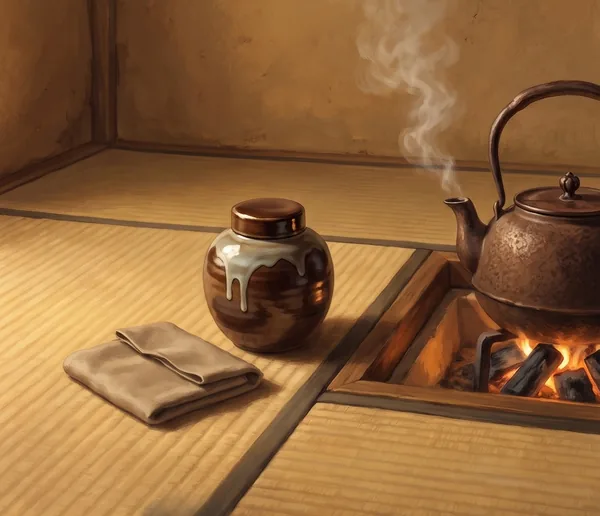
Tea, and Kobori Enshū
Later the kiln worked under the guidance of the tea master Kobori Enshū, and brought methods from Mino to its Shirahata kiln. Japanese call this period Enshū-Takatori (遠州高取). This period is associated with Takatori’s development as a kiln for tea wares.
03 · 窯と系統
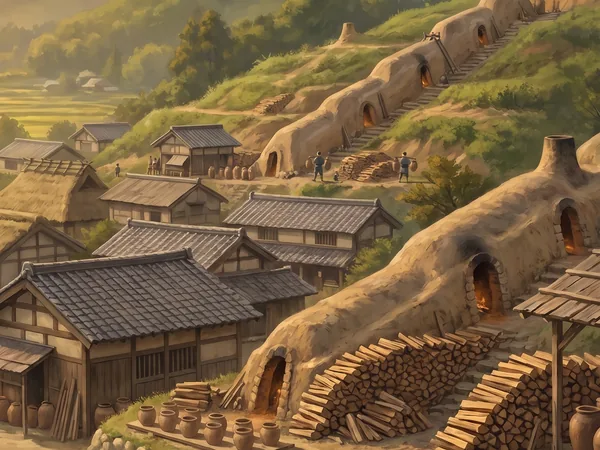
Kilns and lines
In 1665 the second Hachizō opened a kiln at Koishiwara. Japanese call this Koishiwara-Takatori (小石原高取).
In the early eighteenth century, domain production was established nearer Fukuoka. The East Sarayama kiln is dated by Fukuoka City’s cultural record to 1716, and continued until the abolition of the domain system in 1871.
When the domains ended, the kilns lost their protection and declined. The tradition survived, at Koishiwara among other places.
-
Early 1600s
The first kiln
A Korean potter, Hachizan, builds a kiln at the foot of Mount Takatori for Kuroda Nagamasa.
-
1614
A larger kiln
The kiln moves to Uchigaso.
-
Later
Enshū-Takatori
Tea wares made under the guidance of Kobori Enshū, at the Shirahata kiln.
-
1665
Koishiwara
The second Hachizō opens a kiln at Koishiwara.
-
1716
East Sarayama
A domain kiln opened near Fukuoka and remained in operation until 1871.
-
1871
Domain kilns end
With the end of the domain system the kilns lost the domain’s protection and declined; the tradition survives at Koishiwara among other places.
04 · 盆器
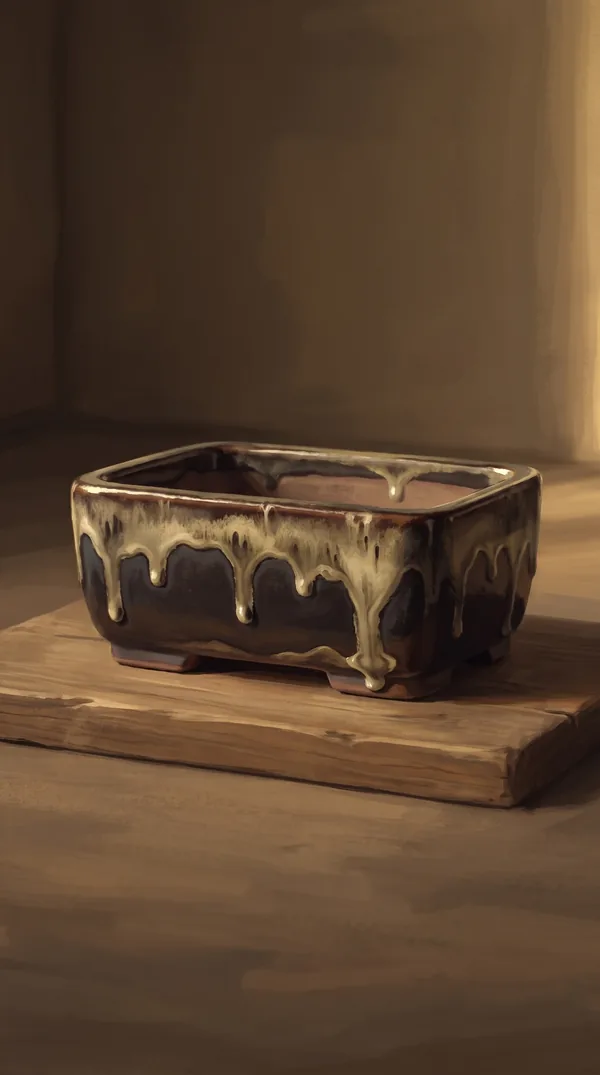
Takatori bonsai pots
When were Takatori bonsai pots made? The honest answer is that it is not settled. The reference we follow says they may also have been made at the older domain kilns, but that there is no proof. It suggests that most Takatori bonsai pots known in the bonsai world were probably made after the kilns left domain hands.
The six pots it illustrates are all in Takatori glaze. Their listed sizes run from 9.2 × 4.6 cm to 35.5 × 25.5 × 12 cm: round pots with outer rims, a mokkō-shaped pot, rectangles, and a large rectangle with indented corners.
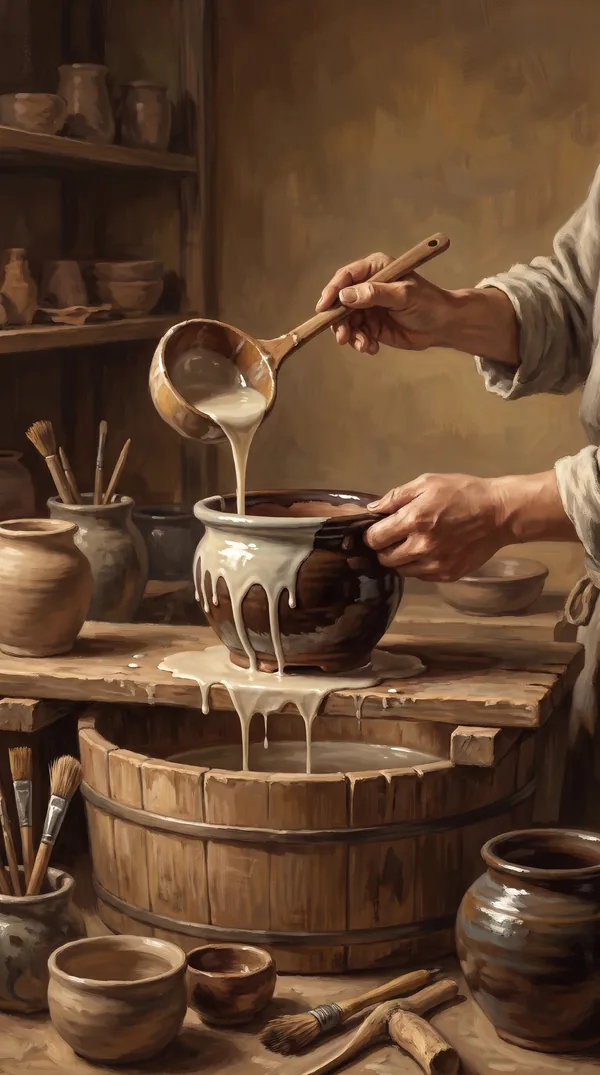
The largest of the six, the 35.5 cm rectangle, is described as among the largest Takatori bonsai pots, and it shows how the look is made. An iron-rich base glaze goes on first. A straw-ash glaze is then poured over it, and the silica in the ash turns cloudy white where it runs. The drips are the result of that double glazing.
05 · 釉と産地
The glaze is not the place
“Takatori glaze” is the name of a glaze, and it is used well beyond Takatori. The reference names Heian Tōfukuji among the potters who use it, and notes that it is common in modern ceramics. A pot in Takatori glaze may have been made outside the Takatori kiln traditions. The glaze name alone does not identify a pot as Takatori ware.
The reference suggests the glaze developed from a Seto glaze introduced in the Enshū period, a crystalline glaze made from a material called kurohama, which was improved and double-dipped with a Korean-style straw-ash glaze. That Seto glaze is known as kin-nagashi in Seto and as Seto-nagashi in Izumo.
06 · 見方

Reading a Takatori pot
The reference describes Takatori bonsai pots as commonly carrying a kiln mark rather than an individual potter’s name, reflecting the kiln’s history as a domain kiln. A documented form is the character 高 inside a circle. That mark does not by itself date a pot.
If a mark puzzles you, send us a clear photograph and we will tell you what it says.
07 · YAKUMO と高取焼
Takatori at YAKUMO JAPAN
Current availability changes, and we may not have a Takatori pot listed at any given time. Our pots are grouped on eBay by kiln and origin. The pictures on this page are illustrations, not pots for sale.
Browse bonsai pots by kiln and origin on eBay →
Listings ship from Tokyo; destination availability and terms are shown on eBay.
08 · Continue
Keep reading
The kilns and glazes on this page each have more to say on their own pages.