Makers · 作家 · Tokoname
Reiho
黎鳳b. 1952
Tokoname built its name on unglazed clay, and when he started there were few there working mainly in glaze. He went that way anyway, after the colours of the old Chinese imports — and was recorded in 2006 among the makers who represent glazed bonsai ware for the whole of Japan, not only for Tokoname.
At a glance
- Art name
- Reihō 黎鳳
- Real name
- 片岡勝資
- Born
- 1952
- Family
- Son of the Tokoname potter 誠山 (片岡誠)
- Trained
- Tokoname high school ceramics course, graduated 1972; then the advanced course at Seto, then glaze research at the Seto branch of the Nagoya industrial testing institute
- Workshop
- Seizan pottery 誠山陶園
- Field
- Glazed tree pots and glazed suiban
- Glazes
- White and yellow kōchi, kinyū, ruri, oribe
- From c. 1996
- Also 南蛮-style unglazed stoneware
01 · 釉 The glazes
Going the other way in Tokoname
Tokoname is unglazed-ware country. Up to that point few there had worked mainly in glaze, and part of his early reputation came from being one of the few who did.
What he set out to do was recreate the glazes of the old and middle-period Chinese imports — white kōchi, yellow kōchi, kinyū — and he had a name for it young.
But the scarcity is not allowed to do the explaining. Being one of few would not by itself have won this much regard if the colours themselves had not been worth having. What he is credited with is a fully vitrified body under a soft finish — the combination you meet in Chinese glazed ware, and the mark of fine work.
One of the makers who represent glazed bonsai ware for Japan, not only for Tokoname.
He and Ikkō are set together as the two leading makers of glazed bonsai ware in Tokoname.
He trained for it: ceramics at Tokoname high school to 1972, then the advanced course at Seto, then glaze research at the Seto branch of the Nagoya industrial testing institute. Together these gave him a grounding in pottery, porcelain and glaze.
02 · 型 The form
A shape the Chinese pots did not have
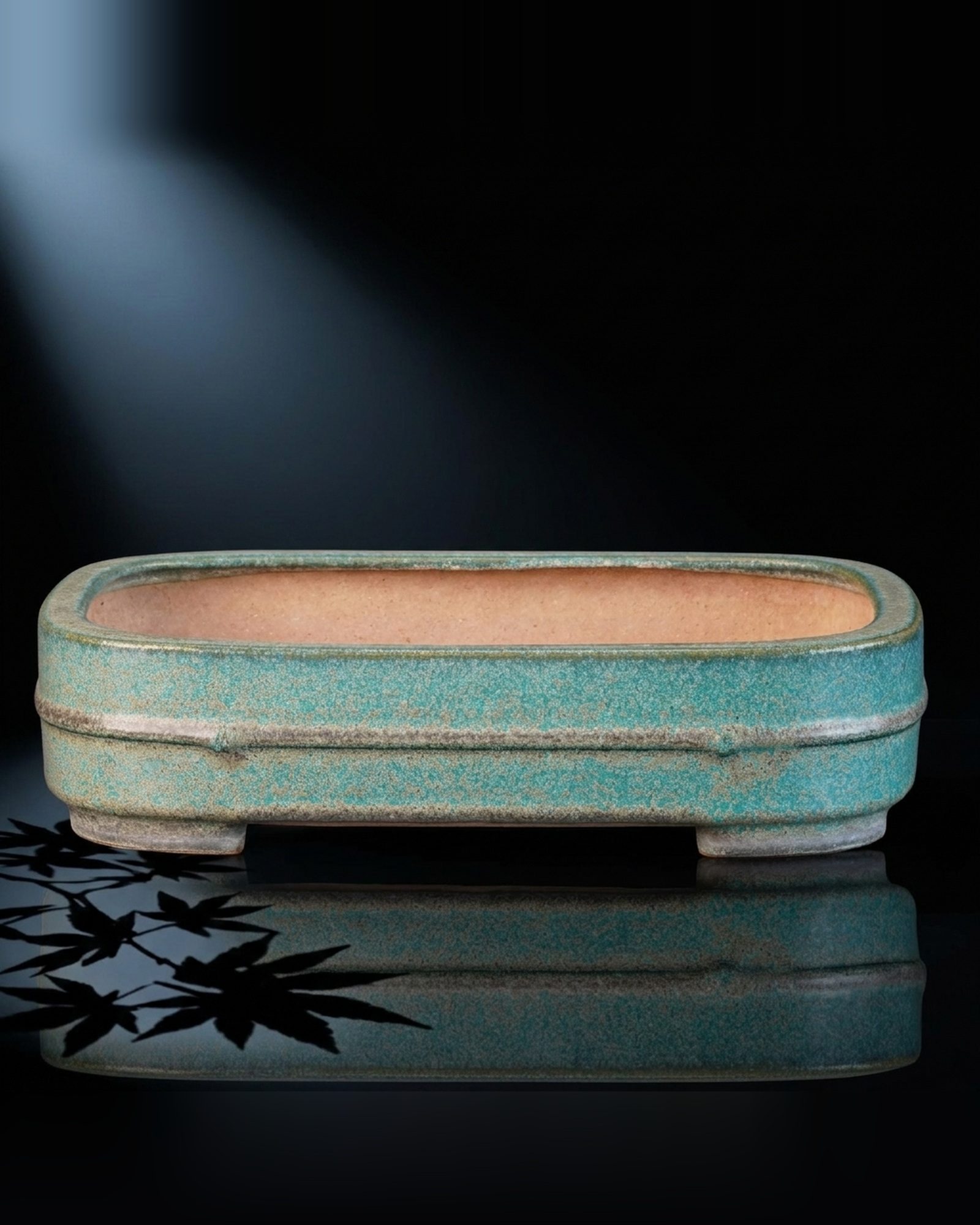
An oribe oval with a banded rim and a waist band carries the most useful note about him.
When people first saw this form, it says, many will have felt that a maker with a new sensibility had arrived in Tokoname — because there was no form like it among the older Chinese pots.
Then it explains why that is harder than it sounds. The difference is only in the shape, the number and the position of the waist bands. But the Chinese repertoire is so nearly complete that creating a form which stands outside it is very difficult indeed. The quiet blue-green oribe makes it usable as well, and the 2006 account says it was still being made then.
03 · 年代 Dating
Glaze first, nanban later
The main line is glaze, and it is what the name was made on.
From about 1996 he began making 南蛮, nanban-style unglazed stoneware in earnest. The ones with ash glaze caught on part of the body are singled out as good; they cost less than his glazed pots, and by 2006 they had started turning up at shows often.
So Reiho’s nanban-style unglazed work belongs to the later line, and to a different part of the work from the one that made his name.
04 · 落款 The mark
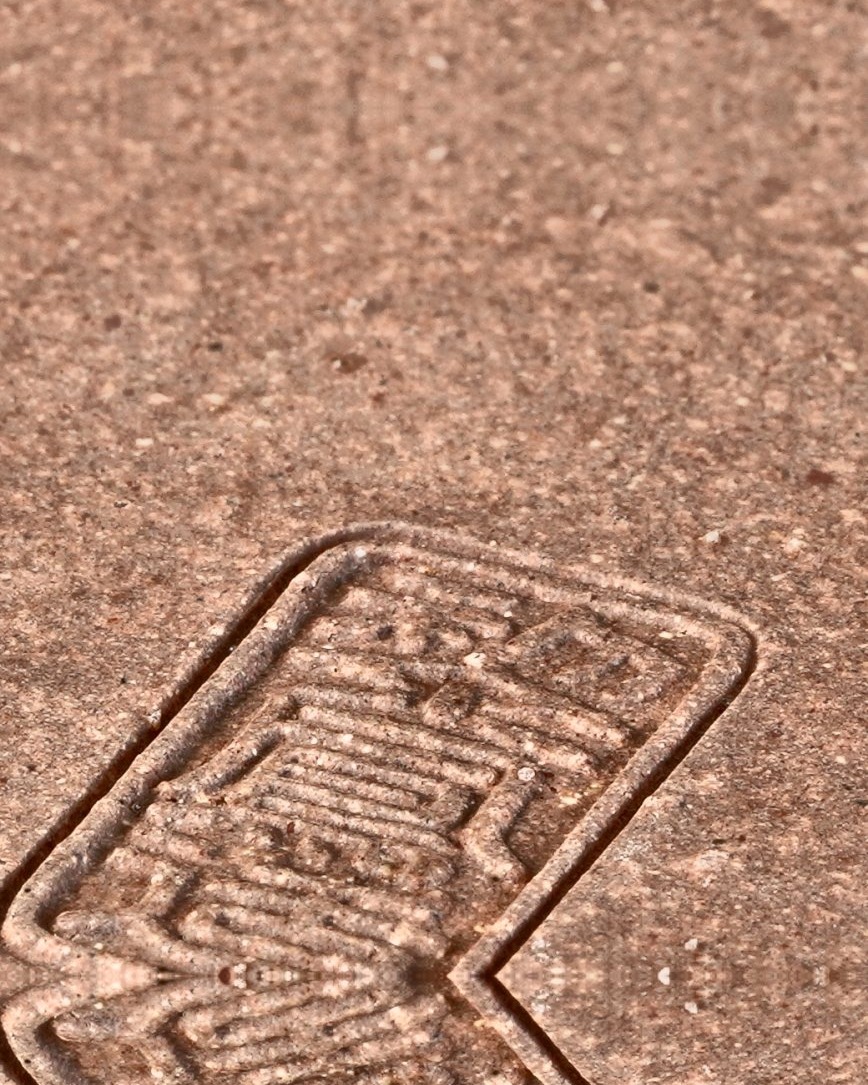
A raised mark inside a rounded rectangular frame.
A mark that is not the documented one
The foot of a Reihō pot.
It is not the impression documented here. The documented one is 黎鳳造, cut intaglio and standing upright. This one stands proud of the clay inside a rounded rectangular frame.
A second mark is named without an impression: 黎鳳造印, in use by 2006. Whether this is that one is not established.
05 · 落款 The mark
Two documented marks
One has a documented impression. The other is known by wording only.
| Mark | Reading | Note |
|---|---|---|
| 黎鳳造 | Intaglio, a tall upright seal — impression documented | The documented mark. |
| 黎鳳造印 | Named in text only — in use by 2006 | No impression is documented for it. |
What the mark does not tell you
No exclusive association between either documented mark and glazed or 南蛮 work is documented. And 黎鳳 is not 礼峰 of the Matsushita pottery, which is read the same way.
06 · 代表作 Recorded works
Recorded works
Not for sale — four works recorded for this maker. All four are glazed, and all four are ovals. The tree photographed alongside them is a chabo-hiba, 105 cm tall, in a Reiho 南蛮 round.
| Work | Size (cm) |
|---|---|
| Oribe oval, banded rim, waist band — the form that had no Chinese precedent, and was still being made in 2006 | 50 × 36 × 5 |
| White kōchi oval, outer rim — after the refined Chinese Yixing pots of the middle period, Ge Mingxiang and Ge Dehe among them, and made entirely his own. The soft yellow-white that white kōchi is most valued for comes out well here | 58.5 × 42.5 × 6.8 |
| Ruri oval, outer rim — the deeper ‘okame oval’ form. Good for growing and good to look at, and right for fruiting or flowering trees that need some depth of soil. The Canton pots have fine forms of this kind; the thickly laid ruri is a different pleasure from an old pot | 55 × 45 × 11 |
| Kinyū oval suiban, bag form — thinly built and finely balanced. A form this even is said to be very hard in earthenware, whatever it may be in porcelain. The glaze is remarkably uniform, and laid so thinly that some special method of applying it — blown on, perhaps — is suspected | 56.5 × 39.8 × 4.8 |
Available
Reiho pots in the collection
Each pot ships worldwide from Tokyo.
Send us a photograph of the underside and we will tell you what the mark says.