Makers · 作家 · Tokoname
Ikko
一弘b. 1956
The son of a Tokoname potter who picked a field his father had not worked — glaze — and started at the smallest end of it. His work bears three written forms of the name, and all three are his.
At a glance
- Art name
- Ikkō 一弘 — also 壱興 and 壹興
- Real name
- Kazuhiro Watanabe 渡辺一弘
- Born
- 1956, Tokoname
- Family
- Son of the Tokoname potter Seizan 正山
- Trained
- Tokoname high school ceramics course, then the advanced course at Seto 瀬戸窯業高校専攻科, then under his father while researching glaze
- Kiln
- Gas
- From 1978
- Glazed small-size tree pots
- From c. 1981
- Medium tree pots and suiban
- Forming
- Slab-built タタラ chiefly
- Glazes
- Oribe, kinyū, white and yellow kōchi, ruri, and the tones between. Unglazed small pots as well
01 · 落款 The names
Three ways of writing one name
This is the thing to settle before you buy, because a listing title will not settle it.
Three written forms are documented here: 一弘, 壱興 or 壹興. The note is plain: the second and third are the marks used on small pots made in partnership with bonsai nurseries, and the reading is the same in every case. One man, one name, three documented sets of characters.
Three marks, one man — and both readings are in use.
The reading is the second half of the problem. Read as ordinary Japanese, 一弘 gives Kazuhiro, which is his given name. It is generally read Ikkō, and both readings point to the same man.
02 · 釉 The glazes
What a gas kiln does to a single glaze
Two of the pieces documented here are worth reading closely, because they explain what you are looking at when an Ikkō pot seems to be two colours at once.
On the small green rectangle, the glaze lies thin over the body and fires to the Canton green cast; where it has gone on thick at the lower part and in the indented corners it comes up as kinyū proper, the purple-red. Same glaze, same firing, two colours — and it is put down to the gas kiln.
The other is a yellow kinyū oval. Few makers offer a yellow kinyū at all. It is laid over the classical cloud-foot form that suits a noble yellow, and the body clay was chosen with a strong red cast to bring the yellow up — the glaze and the clay under it picked together.
He is set alongside Reihō as one of the two leading makers of glazed bonsai ware in Tokoname.
03 · 年代 Dating
What the kind of pot tells you about its date
He began firing glazed small-size tree pots in a gas kiln in 1978, and took on medium tree pots and suiban from about 1981. So an Ikkō suiban dates from around 1981 or later, whatever else is said about it.
One piece dates itself exactly. The group of three — an iro-e rectangle, a blue-glazed round and a shudei rectangle — was shown at the first Modern Small Pot Makers’ Exhibition in January 2006.
There is also a direction of travel. Large Ikkō pots exist, but the work had narrowed over the years towards medium and small sizes, with the large pieces probably made to order.
04 · 実物 The mark on this pot
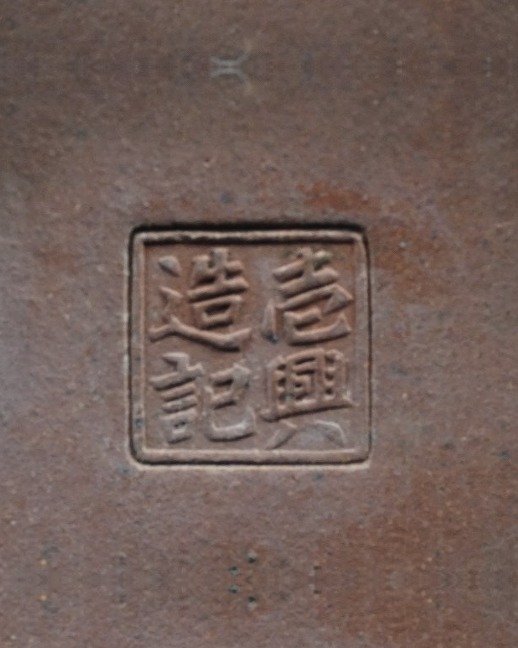
壱興造記 — a square framed stamp.
A partnership mark, not 一弘造印
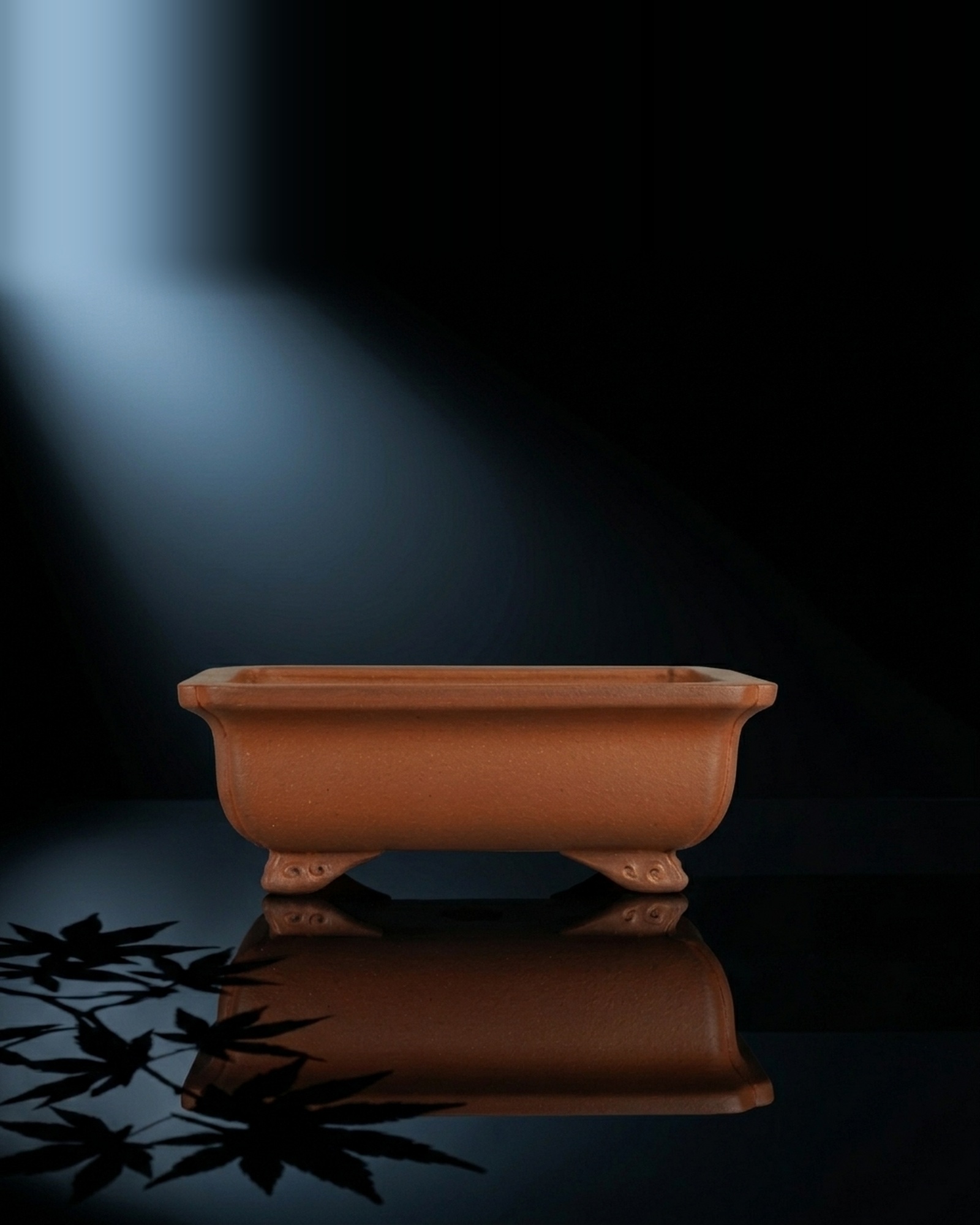
The foot of the pot at the top of the page. A square frame with four characters inside it, read down the right column and then the left: 壱興造記.
The record identifies 壱興造記 as one of the partnership marks, rather than 一弘造印. So this pot belongs to the small-pot work made in partnership with bonsai nurseries — and it is still his.
Which is the whole use of knowing the documented forms. The characters on the foot are not the same, and the maker is.
05 · 落款 The mark
Three documented marks
All three are square stamps. The first is cut in intaglio, so the characters read light against a dark ground when pressed.
A 一弘造 stamp and nail-written versions are named alongside these, without impressions.
| Mark | Reading | Note |
|---|---|---|
| 一弘造印 | Ikkō-zō-in — intaglio square stamp | One of the representative marks documented here. |
| 壱興造記 | Ikkō-zō-ki — square stamp | Used on small pots made in partnership with bonsai nurseries. |
| 壹興造記 | Ikkō-zō-ki — square stamp | The same partnership use, written with 壹. |
Same man, different characters
A pot marked 壱興 or 壹興 is not by a second maker. The reading is the same and the pots are his.
06 · 代表作 Recorded works
Recorded works
Not for sale — seven entries recorded for this maker, from 11.3 cm to a 60 cm oval.
| Work | Size (cm) |
|---|---|
| Kinyū rectangle, inner rim, straight sides, lower band, indented corners — a deeper kinyū, and the pairing with the exact form is the thing. Many of his pots repeat one form in another glaze, or one glaze in another form | 30 × 25 × 10 |
| Oribe oval, outer rim — marked 壹興. The green type of oribe, with crystalline flecking raised on it. Two shaku across. With this much ability behind him, the choice to put his effort into small and medium pots may have been a way of staying out of other makers’ ground | 60 × 45 × 8.5 |
| White kōchi suiban, rectangular, straight sides — a form recalling the celebrated Chinese 留佩 and 珠佩 pots, under a refined white kōchi | 52 × 31.5 × 3 |
| Kinyū suiban, rectangular, straight sides, indented corners — probably from a few years after he took up water trays. Blown on very thinly, going for the traditional kinyū tone | 45 × 27 × 4 |
| Green-glazed rectangle, inner rim, straight sides, indented corners — the piece that shows two colours from one glaze | 14 × 12 × 5 |
| Yellow kinyū oval, outer rim — on a classical cloud-foot form, over a strongly red body chosen to carry the yellow | 16.5 × 12 × 4.5 |
| Three pots shown together, new work at the first Modern Small Pot Makers’ Exhibition, January 2006: an iro-e rectangle — shudei body under white slip, with a landscape drawn on it in a modern manner; a blue-glazed round — porcelain body with stripes in ruri and iron glaze, in the mugiwara manner; and a shudei rectangle, outer rim, indented corners, cloud feet, after the Shōkōdō form with the rim channel left off. The size given is the shudei rectangle only. | 11.3 × 8.8 × 4.4 |
Available
Ikko pots in the collection
Each pot ships worldwide from Tokyo.
Send us a photograph of the underside and we will tell you what the mark says — including whether it matches a form documented here.