Makers · 作家 · Japan
Zeko
是好1900–1989
A film and television actor who did a great deal to spread small bonsai in Japan — and who painted pots. His signature goes on the painted face. A second mark goes on the base, and both are genuine.
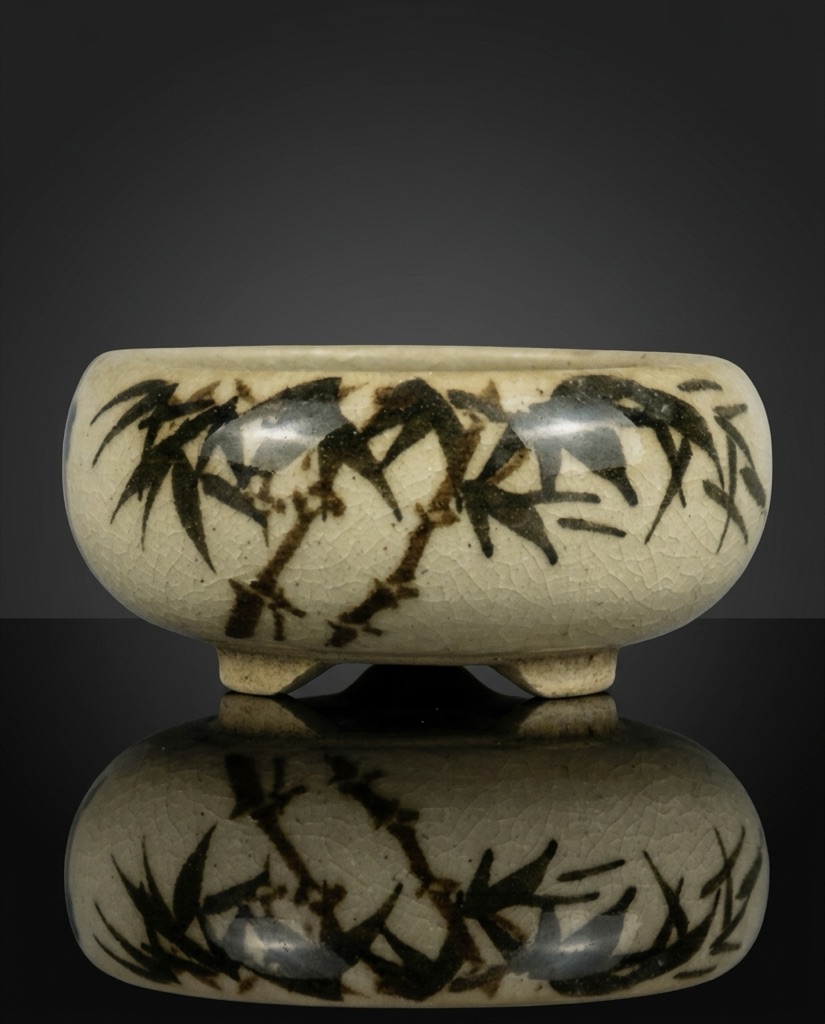
At a glance
- Art name
- Zekō 是好 — a stage name, from the Zen phrase 日々是好日
- Real name
- 中村愚堂
- Dates
- 1900–1989
- Born
- Saga prefecture 佐賀県
- Trade
- Actor — a noted supporting player in post-war film and television
- 1962
- Founding promoter, Tokyo Amateur Small Bonsai Association 東京アマチュア小品盆栽協会
- Also
- Chairman, Japan Small Bonsai Association 日本小品盆栽協会
- Documented systems
- Two confirmed here; both genuine — 是好 on the painted face, 矩 on the base
01 · 経歴 The route in
Trained for the priesthood, then an actor, then pots
He was put into the school at Daitoku-ji in Kyoto to become a priest, and left at nineteen to be an actor instead. 是好 is the stage name, taken from the Zen phrase 日々是好日. After the war he worked steadily as a supporting player in film and television.
Small bonsai reached him through 杉本佐七, who looked after stage design at Shochiku, and it took hold at once. In 1962 he was a founding promoter of the Tokyo Amateur Small Bonsai Association, and he chaired the Japan Small Bonsai Association.
What he did for pots was wider than making them. He made small pots himself; he commissioned them from ceramicists — 辻てるこ and 羽二生隆宏 among them — and in doing so he turned a number of potters’ attention towards bonsai ware in the first place.
02 · 分業 Who made it
Three kinds of Zeko pot
This matters to a buyer, and it is worth being careful about. Three different things all get called Zekō pots.
One. Pots he made himself.
Two. Pots he commissioned from ceramicists.
Three, and this is the main one in his later years. Bodies formed by someone else, painted by him. The record singles out the small pots formed and fired by 紺野心山 and painted by Zekō.
Then there is the fourth word. Elsewhere a white Satsuma square carries the mark 王陶山・是好撰 — a pot he ordered from a Satsuma kiln and did not paint. 撰 means he chose it; 画 means he painted it.
撰 means he chose it. 画 means he painted it.
03 · 落款 The signature
Look in the picture, not at the foot
The point to carry is short: he mostly signed on the picture face, in coloured enamel.
So a bare foot does not mean an unsigned pot. Look at the painting: the signature may be in it, put on with the same colours.
A bare foot does not mean an unsigned pot.
He was not the only one to work this way. The same habit is recorded of 佐野大助, whose 大 also goes on the painted face. A collector who paints signs where he painted.
04 · 矩 The other mark
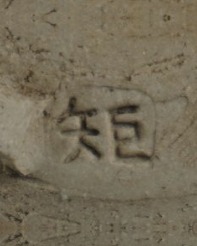
矩 — impressed into the base.
A mark on the base, and it is also his
矩, on the base of a pot handled by us as his. Pressed into the clay, small, inside a shallow panel.
This is a second confirmed signature system, and it is genuine. It is not among the forms documented here, which carry only the brushed 是好 on the painted face. The two sit in two places: the signature in the picture, and this one underneath.
We got this wrong once. Finding 矩 absent from the documented forms, we read that as meaning it did not exist, and called it a misreading of 是好. It is not. Absence from a book is not evidence against a pot.
05 · 落款 The mark
Two confirmed signature systems in two places, and a third word
Where the mark is matters more here than what it says. Two of these are his signature, in two different places. The third is not a signature at all — it marks a pot he ordered rather than painted.
| Mark | Reading | Note |
|---|---|---|
| 是好 | Brushed in enamel, on the painted face | The documented form. Two characters run together, written with a light touch. |
| 矩 | Impressed or carved, on the base | Also genuine. Not among the forms documented here. |
| 是好撰 | Chosen by Zekō | On a pot he ordered and did not paint. Recorded on a white Satsuma square alongside the kiln’s own mark. |
06 · 代表作 Recorded works
Recorded works
Not for sale — four pots recorded for him, and a planting. All four are shallow rounds between 6.1 and 7.1 cm across. No angular forms and nothing large appears.
| Work | Size (cm) |
|---|---|
| Round, flowering plants in underglaze blue | 7.1 × 2.8 |
| Round, bag form, flowering plants in underglaze blue | 6.2 × 3.7 |
| Round, bag form, a crab in enamel colours | 6.1 × 2.6 |
| Round, a pomegranate in enamel colours | 6.6 × 3.7 |
| Round, a tea-drinking scene in underglaze blue — photographed with an akebi of 10 cm in it | — |
Available
Zeko pots in the collection
Each pot ships worldwide from Tokyo.
Send us a photograph of the pot — the painted side as well as the base — and we will tell you what the mark says and where it is.