Makers · 作家 · Echizen, Fukui
Echizen Bunzan
越前文山Sabae Engei opened in 1973. He began making pots the same year. What follows is the work of someone who came to clay from the growing side of the trade, and who built his own manner inside the 越前焼 tradition already on his doorstep.
At a glance
Drawn from the standard Japanese survey of bonsai ware and checked against pots we have handled. The survey gives no birth year and no generation, so neither appears here.
- Art name
- Echizen Bunzan 越前文山
- Real name
- Kaoru Ito 伊藤 薫
- Region
- Echizen, Fukui 越前・福井県
- Nursery
- Sabae Engei 鯖江園芸, opened 1973
- Began potting
- 1973 — the same year
- Tradition
- Echizen ware 越前焼
- Works in
- Hand-built unglazed stoneware; shinsha and other glazes; inlay
- Marks recorded
- Two
01 · 園と窯 The nursery and the kiln
He came to pots from the growing side
Most of the makers in this reference are potters who found bonsai. Bunzan arrives the other way round.
In 1973 he opened Sabae Engei, a horticultural nursery in Fukui. The survey records that he began making pots the same year — not later, once the nursery was established, but at the same time. Growing and making start together.
It is a small detail and easy to read past. But a pot is a growing container before it is anything else, and it is worth knowing when the person who made it spent his working life on both sides of that relationship.
一九七三年、鯖江園芸を開園。同年、作陶を始める。
02 · 越前 The local tradition
Working inside a tradition, not around it
Echizen is an old kiln region on the Japan Sea coast of Fukui, a long way from the Tokoname workshops that supply most bonsai pots.
The survey is precise about his relationship to it: he worked in accordance with the Echizen ware handed down locally, and established his own manner within it. Not a break from the tradition, and not a copy of it either.
What comes out of that is broad. Hand-built yakishime — unglazed, high-fired, the clay left to speak — sits alongside glazed work including shinsha, the copper red that is difficult to fire predictably, and pieces finished with inlay.
03 · 赤絵 A pot we handled
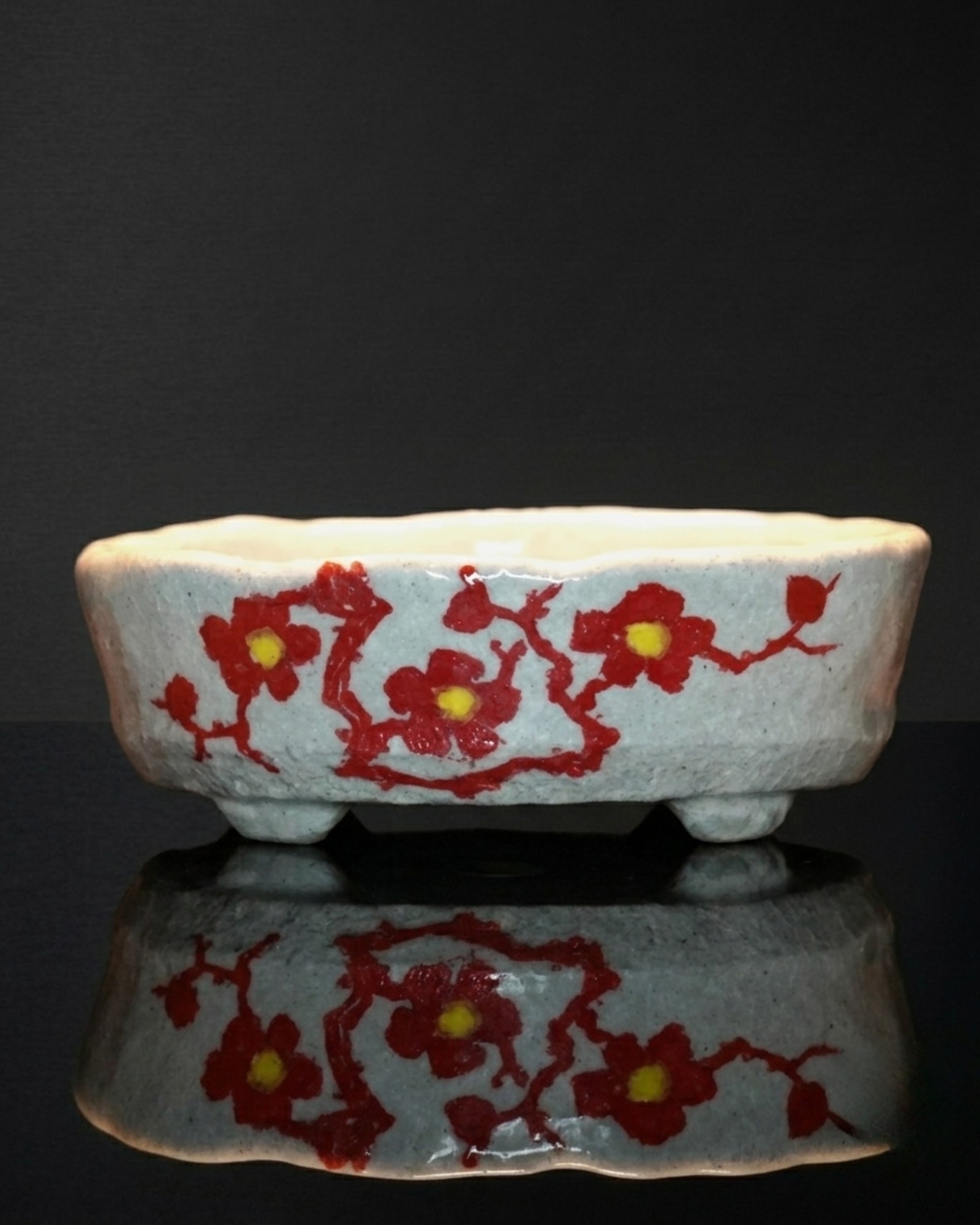
Echizen Bunzan · enamelled plum · 9.2 cm · photographed by us
Red plum, on a white ground
This one passed through our hands. Red plum — blossom and branch — drawn over a white ground, on a small lobed pot a little over nine centimetres across.
We show it because it belongs to the same vein the survey singles out. The plum turns up again on the piece it chose to comment on, and that comment is the most interesting sentence written about him.
04 · 乾山 A question the survey asks
Whether the plum is a bow to Kenzan
Of the three pots reproduced in the survey, one draws a remark. It is a six-sided enamelled piece: the trunk of an old plum laid down boldly in sabi-e, iron-brown underglaze, with the blossom picked out in colour over it.
The survey wonders aloud whether it is a quiet homage to Ogata Kenzan.
“Perhaps a quiet homage to Kenzan.”
Kenzan (1663–1743) worked in Kyoto, the younger brother of the painter Ogata Korin — the two of them collaborated, Kenzan throwing and Korin painting. He is known above all for sabi-e, the same iron-brown painting named in that sentence. Iron-brown plum, colour over the top: the vocabulary lines up.
The survey stops at wondering, and so do we. But it is a long reach for a modern Fukui potter, and someone thought it worth putting in print.
05 · 落款 The seals
Two marks in the survey, and a third we have seen
Bunzan signs as 文山 — the second half of the name — or with the full 越前文山 in a framed stamp.
A third form does not appear in the survey at all. We record it here because we have seen it on a pot ourselves, and because a mark you cannot place is worth more to you described than left out.
| Mark | Reading | Note |
|---|---|---|
| 文山 | Bunzan — carved | Two characters cut into the foot with a tool. The grooves are deep and read easily. |
| 越前文山 | Echizen Bunzan — stamped | The full name, impressed inside a rounded rectangular frame. |
| 文山 | Bunzan — painted in blue (not in the survey) | Brushed under the glaze in cobalt, with a square kiln mark beside it. Observed by us on a pot we handled, June 2026 — not recorded in the printed reference. |
Carved, stamped, painted
Three ways of putting the same name on a pot. We do not yet know whether they track period, technique or simply what was to hand. If you own a Bunzan pot and can photograph the mark, we would like to see it.
Photographs of these marks on pots from our own stock will be added here. A mark in the hand rarely looks like a printed plate — clay, glaze pooling and wear all change it.
06 · 代表作 Documented works
Pieces recorded in the literature
Not for sale — the reference pieces published in the standard Japanese survey.
| Work | Size (cm) |
|---|---|
| Unglazed round with corded rim | — |
| Enamelled hexagon — old plum in sabi-e, blossom in colour | — |
| White-glazed round with rope rim, decoration cut back through the slip | 17.5 × 8 |
07 · 用語 Glossary
The words on the label
- 焼締 yakishime
- Unglazed high-fired stoneware — the clay itself is the finish.
- 手びねり tebineri
- Built by hand rather than thrown on a wheel.
- 辰砂 shinsha
- Copper red — a glaze that is difficult to fire predictably.
- 象嵌 zōgan
- Inlay — one clay set into another.
- 錆絵 sabi-e
- Iron-brown painting under the glaze.
- 色絵 iro-e
- Enamel colour applied over the glaze.
- 掻落 kaki-otoshi
- Decoration cut back through a coating of slip.
- 縄縁 nawa-buchi
- A rim worked to look like laid rope.
Available
Echizen Bunzan pots in the collection
We handle Bunzan occasionally. Each pot is 一点物 ittenmono — one of one — and ships worldwide from Tokyo.
Sources
盆器大図鑑【上巻】 Bonki Daizukan, Vol. 1, p. 183. Checked against pots handled by YAKUMO JAPAN. Last verified 19 July 2026.
Where the record is unclear we say so rather than guess.
One correction to the source. The survey prints the name as 尾形幹山. No potter of that name exists; the reference is to Ogata Kenzan 尾形乾山 (1663–1743), whose sabi-e is named in the same sentence. We have used the corrected form above.